


Page 583 - Textbook of Pathology, 6th Edition
P. 583
567


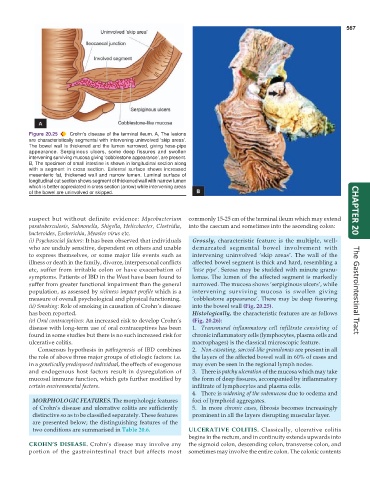
           Figure 20.25  Crohn’s disease of the terminal ileum. A, The lesions
           are characteristically segmental with intervening uninvolved ‘skip areas’.
           The bowel wall is thickened and the lumen narrowed, giving hose-pipe
           appearance. Serpiginous ulcers, some deep fissures and swollen
           intervening surviving mucosa giving ‘cobblestone appearance’, are present.
           B, The specimen of small intestine is shown in longitudinal section along
           with a segment in cross section. External surface shows increased
           mesenteric fat, thickened wall and narrow lumen. Luminal surface of
           longitudinal cut section shows segment of thickened wall with narrow lumen
           which is better appreciated in cross section (arrow) while intervening areas
           of the bowel are uninvolved or skipped.


           suspect but without definite evidence:  Mycobacterium  commonly 15-25 cm of the terminal ileum which may extend  CHAPTER 20
           paratuberculosis,  Salmonella,  Shigella, Helicobacter, Clostridia,  into the caecum and sometimes into the ascending colon:
           bacteroides, Escherichia, Measles virus etc.
           ii) Psychosocial factors: It has been observed that individuals  Grossly, characteristic feature is the multiple, well-
           who are unduly sensitive, dependent on others and unable  demarcated segmental bowel involvement with
           to express themselves, or some major life events such as  intervening uninvolved ‘skip areas’. The wall of the
           illness or death in the family, divorce, interpersonal conflicts  affected bowel segment is thick and hard, resembling a
           etc, suffer from irritable colon or have exacerbation of  ‘hose pipe’. Serosa may be studded with minute granu-
           symptoms. Patients of IBD in the West have been found to  lomas. The lumen of the affected segment is markedly
           suffer from greater functional impairment than the general  narrowed. The mucosa shows ‘serpiginous ulcers’, while
           population, as assessed by sickness impact profile which is a  intervening surviving mucosa is swollen giving  The Gastrointestinal Tract
           measure of overall psychological and physical functioning.  ‘cobblestone appearance’. There may be deep fissuring
           iii) Smoking: Role of smoking in causation of Crohn’s disease  into the bowel wall (Fig. 20.25).
           has been reported.                                    Histologically, the characteristic features are as follows
           iv) Oral contraceptives: An increased risk to develop Crohn’s  (Fig. 20.26):
           disease with long-term use of oral contraceptives has been  1. Transmural inflammatory cell infiltrate consisting of
           found in some studies but there is no such increased risk for  chronic inflammatory cells (lymphocytes, plasma cells and
           ulcerative colitis.                                   macrophages) is the classical microscopic feature.
              Consensus hypothesis in pathogenesis of IBD combines  2. Non-caseating, sarcoid-like granulomas are present in all
           the role of above three major groups of etiologic factors: i.e.  the layers of the affected bowel wall in 60% of cases and
           in a genetically predisposed individual, the effects of exogenous  may even be seen in the regional lymph nodes.
           and endogenous host factors result in dysregulation of  3. There is patchy ulceration of the mucosa which may take
           mucosal immune function, which gets further modified by  the form of deep fissures, accompanied by inflammatory
           certain environmental factors.                        infiltrate of lymphocytes and plasma cells.
                                                                 4. There is widening of the submucosa due to oedema and
            MORPHOLOGIC FEATURES. The morphologic features       foci of lymphoid aggregates.
            of Crohn’s disease and ulcerative colitis are sufficiently  5. In more  chronic cases, fibrosis becomes increasingly
            distinctive so as to be classified separately. These features  prominent in all the layers disrupting muscular layer.
            are presented below; the distinguishing features of the
            two conditions are summarised in Table 20.6.       ULCERATIVE COLITIS.  Classically, ulcerative colitis
                                                               begins in the rectum, and in continuity extends upwards into
           CROHN’S DISEASE.  Crohn’s disease may involve any   the sigmoid colon, descending colon, transverse colon, and
           portion of the gastrointestinal tract but affects most  sometimes may involve the entire colon. The colonic contents

