


Page 584 - Textbook of Pathology, 6th Edition
P. 584
568


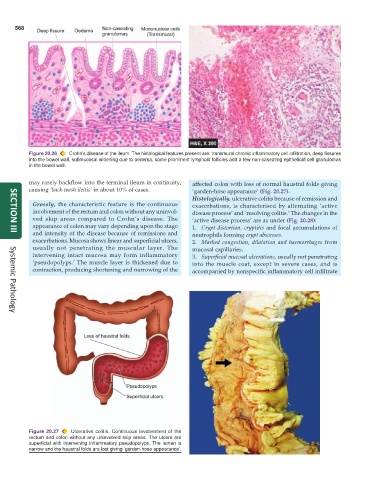
           Figure 20.26  Crohn’s disease of the ileum. The histological features present are: transmural chronic inflammatory cell infiltration, deep fissures
           into the bowel wall, submucosal widening due to oedema, some prominent lymphoid follicles and a few non-caseating epithelioid cell granulomas
           in the bowel wall.

           may rarely backflow into the terminal ileum in continuity,  affected colon with loss of normal haustral folds giving
           causing ‘back-wash ileitis’ in about 10% of cases.    ‘garden-hose appearance’ (Fig. 20.27).
                                                                 Histologically, ulcerative colitis because of remission and
            Grossly, the characteristic feature is the continuous  exacerbations, is characterised by alternating ‘active
            involvement of the rectum and colon without any uninvol-  disease process’ and ‘resolving colitis.’ The changes in the
            ved skip areas compared to Crohn’s disease. The      ‘active disease process’ are as under (Fig. 20.28):
            appearance of colon may vary depending upon the stage  1. Crypt distortion, cryptitis and focal accumulations of
            and intensity of the disease because of remissions and  neutrophils forming crypt abscesses.
     SECTION III
            exacerbations. Mucosa shows linear and superficial ulcers,  2. Marked congestion, dilatation and haemorrhages from
            usually not penetrating the muscular layer. The      mucosal capillaries.
            intervening intact mucosa may form inflammatory      3. Superficial mucosal ulcerations, usually not penetrating
            ‘pseudopolyps.’ The muscle layer is thickened due to  into the muscle coat, except in severe cases, and is
            contraction, producing shortening and narrowing of the  accompanied by nonspecific inflammatory cell infiltrate


     Systemic Pathology


           Figure 20.27  Ulcerative colitis. Continuous involvement of the
           rectum and colon without any uninvolved skip areas. The ulcers are
           superficial with intervening inflammatory pseudopolyps. The lumen is
           narrow and the haustral folds are lost giving ‘garden-hose appearance’.

