


Page 585 - Textbook of Pathology, 6th Edition
P. 585
569


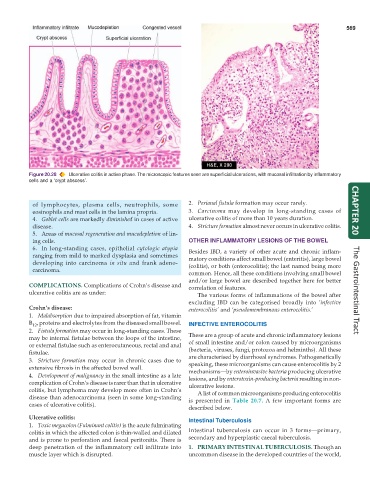
           Figure 20.28  Ulcerative colitis in active phase. The microscopic features seen are superficial ulcerations, with mucosal infiltration by inflammatory
           cells and a ‘crypt abscess’.


            of lymphocytes, plasma cells, neutrophils, some    2. Perianal fistula formation may occur rarely.
            eosinophils and mast cells in the lamina propria.  3. Carcinoma may develop in long-standing cases of     CHAPTER 20
            4. Goblet cells are markedly diminished in cases of active  ulcerative colitis of more than 10 years duration.
            disease.                                           4. Stricture formation almost never occurs in ulcerative colitis.
            5. Areas of mucosal regeneration and mucodepletion of lin-
            ing cells.                                         OTHER INFLAMMATORY LESIONS OF THE BOWEL
            6. In long-standing cases, epithelial  cytologic atypia  Besides IBD, a variety of other acute and chronic inflam-
            ranging from mild to marked dysplasia and sometimes  matory conditions affect small bowel (enteritis), large bowel
            developing into carcinoma  in situ and frank adeno-  (colitis), or both (enterocolitis); the last named being more
            carcinoma.
                                                               common. Hence, all these conditions involving small bowel
                                                               and/or large bowel are described together here for better
           COMPLICATIONS. Complications of Crohn’s disease and  correlation of features.
           ulcerative colitis are as under:                       The various forms of inflammations of the bowel after  The Gastrointestinal Tract
                                                               excluding IBD can be categorised broadly into  ‘infective
           Crohn’s disease:                                    enterocolitis’ and ‘pseudomembranous enterocolitis.’
           1. Malabsorption due to impaired absorption of fat, vitamin
           B , proteins and electrolytes from the diseased small bowel.  INFECTIVE ENTEROCOLITIS
            12
           2. Fistula formation may occur in long-standing cases. These
           may be internal fistulae between the loops of the intestine,  These are a group of acute and chronic inflammatory lesions
           or external fistulae such as enterocutaneous, rectal and anal  of small intestine and/or colon caused by microorganisms
           fistulae.                                           (bacteria, viruses, fungi, protozoa and helminths). All these
           3. Stricture formation may occur in chronic cases due to  are characterised by diarrhoeal syndromes. Pathogenetically
                                                               speaking, these microorganisms can cause enterocolitis by 2
           extensive fibrosis in the affected bowel wall.      mechanisms—by enteroinvasive bacteria producing ulcerative
           4. Development of malignancy in the small intestine as a late  lesions, and by enterotoxin-producing bacteria resulting in non-
           complication of Crohn’s disease is rarer than that in ulcerative  ulcerative lesions.
           colitis, but lymphoma may develop more often in Crohn’s  A list of common microorganisms producing enterocolitis
           disease than adenocarcinoma (seen in some long-standing  is presented in  Table 20.7. A few important forms are
           cases of ulcerative colitis).
                                                               described below.
           Ulcerative colitis:                                 Intestinal Tuberculosis
           1. Toxic megacolon (Fulminant colitis) is the acute fulminating
           colitis in which the affected colon is thin-walled and dilated  Intestinal tuberculosis can occur in 3 forms—primary,
           and is prone to perforation and faecal peritonitis. There is  secondary and hyperplastic caecal tuberculosis.
           deep penetration of the inflammatory cell infiltrate into  1. PRIMARY INTESTINAL TUBERCULOSIS. Though an
           muscle layer which is disrupted.                    uncommon disease in the developed countries of the world,

