


Page 587 - Textbook of Pathology, 6th Edition
P. 587
571


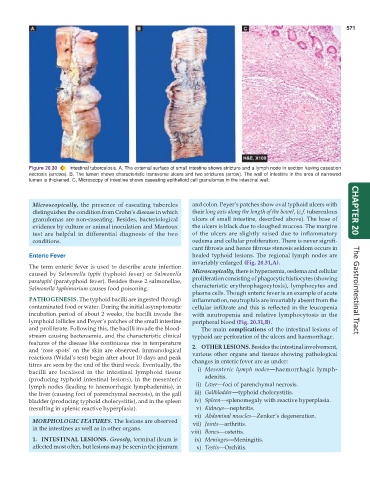
           Figure 20.30  Intestinal tuberculosis. A, The external surface of small intestine shows stricture and a lymph node in section having caseation
           necrosis (arrows). B, The lumen shows characteristic transverse ulcers and two strictures (arrow). The wall of intestine in the area of narrowed
           lumen is thickened. C, Microscopy of intestine shows caseating epithelioid cell granulomas in the intestinal wall.


            Microscopically, the presence of caseating tubercles  and colon. Peyer’s patches show oval typhoid ulcers with
            distinguishes the condition from Crohn’s disease in which  their long axis along the length of the bowel, (c.f. tuberculous  CHAPTER 20
            granulomas are non-caseating. Besides, bacteriological  ulcers of small intestine, described above). The base of
            evidence by culture or animal inoculation and Mantoux  the ulcers is black due to sloughed mucosa. The margins
            test are helpful in differential diagnosis of the two  of the ulcers are slightly raised due to inflammatory
            conditions.                                          oedema and cellular proliferation. There is never signifi-
                                                                 cant fibrosis and hence fibrous stenosis seldom occurs in
           Enteric Fever                                         healed typhoid lesions. The regional lymph nodes are
                                                                 invariably enlarged (Fig. 20.31,A).
           The term enteric fever is used to describe acute infection  Microscopically, there is hyperaemia, oedema and cellular
           caused by  Salmonella typhi (typhoid fever) or  Salmonella  proliferation consisting of phagocytic histiocytes (showing
           paratyphi (paratyphoid fever). Besides these 2 salmonellae,
           Salmonella typhimurium causes food poisoning.         characteristic erythrophagocytosis), lymphocytes and
                                                                 plasma cells. Though enteric fever is an example of acute  The Gastrointestinal Tract
           PATHOGENESIS. The typhoid bacilli are ingested through  inflammation, neutrophils are invariably absent from the
           contaminated food or water. During the initial asymptomatic  cellular infiltrate and this is reflected in the leucopenia
           incubation period of about 2 weeks, the bacilli invade the  with neutropenia and relative lymphocytosis in the
           lymphoid follicles and Peyer’s patches of the small intestine  peripheral blood (Fig. 20.31,B).
           and proliferate. Following this, the bacilli invade the blood-  The main complications of the intestinal lesions of
           stream causing bacteraemia, and the characteristic clinical  typhoid are perforation of the ulcers and haemorrhage.
           features of the disease like continuous rise in temperature  2. OTHER LESIONS. Besides the intestinal involvement,
           and ‘rose spots’ on the skin are observed. Immunological  various other organs and tissues showing pathological
           reactions (Widal’s test) begin after about 10 days and peak  changes in enteric fever are as under:
           titres are seen by the end of the third week. Eventually, the
           bacilli are localised in the intestinal lymphoid tissue  i) Mesenteric lymph nodes—haemorrhagic lymph-
           (producing typhoid intestinal lesions), in the mesenteric  adenitis.
           lymph nodes (leading to haemorrhagic lymphadenitis), in  ii) Liver—foci of parenchymal necrosis.
           the liver (causing foci of parenchymal necrosis), in the gall  iii) Gallbladder—typhoid cholecystitis.
           bladder (producing typhoid cholecystitis), and in the spleen  iv) Spleen—splenomegaly with reactive hyperplasia.
           (resulting in splenic reactive hyperplasia).           v) Kidneys—nephritis.
                                                                 vi) Abdominal muscles—Zenker’s degeneration.
            MORPHOLOGIC FEATURES. The lesions are observed       vii) Joints—arthritis.
            in the intestines as well as in other organs.
                                                                viii) Bones—osteitis.
            1. INTESTINAL LESIONS. Grossly, terminal ileum is    ix) Meninges—Meningitis.
            affected most often, but lesions may be seen in the jejunum  x) Testis—Orchitis.

