


Page 588 - Textbook of Pathology, 6th Edition
P. 588
572                                                      described below. Staphylococcal food poisoning occurs due
                                                               to liberation of enterotoxins by the bacteria.
                                                               2. Clostridial food poisoning.  Infection with anaerobic
                                                               organisms  Clostridium welchii, following consumption of
                                                               contaminated meat results in acute food poisoning (page 181).
                                                               The illness occurs both by bacterial invasion as well as by
                                                               toxins.
                                                               3. Botulism.  This is a severe form of paralysing illness
                                                               caused by ingestion of organism,  Clostridium botulinum,
                                                               which produces neurotoxin.
                                                               4. Salmonella food poisoning (Salmonellosis). This is an
                                                               infection (and not caused by toxins) occurring due to food
                                                               contaminated by S. typhimurium or S. enteritidis. The condition
                                                               manifests with fever, vomiting, and diarrhoea. Death may
                                                               result from depletion of water and electrolytes.
                                                               Dysenteries
                                                               The term ‘dysentery’ is used to mean diarrhoea with
                                                               abdominal cramps, tenesmus and passage of mucus in the
                                                               stools, from any cause. There are 2 main forms of dysen-
                                                               teries—bacillary and amoebic.
                                                               1. BACILLARY DYSENTERY. Bacillary dysentery is the
                                                               term used for infection by shigella species: S. dysenteriae, S.
                                                               flexneri, S. boydii and S. sonnei. Infection occurs by foeco-oral
                                                               route and is seen with poor personal hygiene, in densely
                                                               populated areas, and with contaminated food and water. The
                                                               common housefly plays a role in spread of infection.

                                                                 Grossly, the lesions are mainly found in the colon and
     SECTION III
                                                                 occasionally in the ileum. Superficial transverse
                                                                 ulcerations of mucosa of the bowel wall occur in the region
                                                                 of lymphoid follicles but perforation is seldom seen. The
                                                                 intervening intact mucosa is hyperaemic and oedematous.
                                                                 Following recovery from the acute attack, complete
                                                                 healing usually takes place.
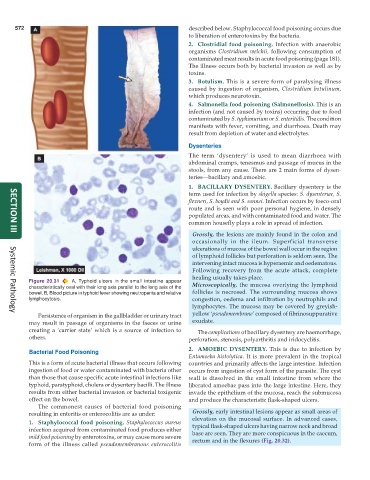
           Figure 20.31  A, Typhoid ulcers in the small intestine appear  Microscopically, the mucosa overlying the lymphoid
           characteristically oval with their long axis parallel to the long axis of the
           bowel. B, Blood picture in typhoid fever showing neutropenia and relative  follicles is necrosed. The surrounding mucosa shows
           lymphocytosis.                                        congestion, oedema and infiltration by neutrophils and
                                                                 lymphocytes. The mucosa may be covered by greyish-
              Persistence of organism in the gallbladder or urinary tract  yellow ‘pseudomembrane’ composed of fibrinosuppurative
     Systemic Pathology
           may result in passage of organisms in the faeces or urine  exudate.
           creating a ‘carrier state’ which is a source of infection to  The complications of bacillary dysentery are haemorrhage,
           others.                                             perforation, stenosis, polyarthritis and iridocyclitis.
                                                               2. AMOEBIC DYSENTERY. This is due to infection by
           Bacterial Food Poisoning
                                                               Entamoeba histolytica. It is more prevalent in the tropical
           This is a form of acute bacterial illness that occurs following  countries and primarily affects the large intestine. Infection
           ingestion of food or water contaminated with bacteria other  occurs from ingestion of cyst form of the parasite. The cyst
           than those that cause specific acute intestinal infections like  wall is dissolved in the small intestine from where the
           typhoid, paratyphoid, cholera or dysentery bacilli. The illness  liberated amoebae pass into the large intestine. Here, they
           results from either bacterial invasion or bacterial toxigenic  invade the epithelium of the mucosa, reach the submucosa
           effect on the bowel.                                and produce the characteristic flask-shaped ulcers.
              The commonest causes of bacterial food poisoning
           resulting in enteritis or enterocolitis are as under:  Grossly, early intestinal lesions appear as small areas of
                                                                 elevation on the mucosal surface. In advanced cases,
           1. Staphylococcal food poisoning.  Staphylococcus aureus  typical flask-shaped ulcers having narrow neck and broad
           infection acquired from contaminated food produces either  base are seen. They are more conspicuous in the caecum,
           mild food poisoning by enterotoxins, or may cause more severe  rectum and in the flexures (Fig. 20.32).
           form of the illness called  pseudomembranous enterocolitis

