


Page 589 - Textbook of Pathology, 6th Edition
P. 589
573


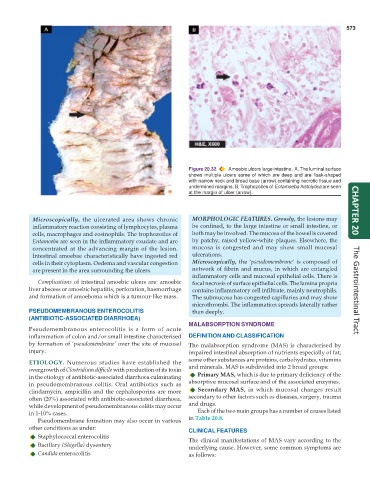
                                                               Figure 20.32  Amoebic ulcers large intestine.  A, The luminal surface
                                                               shows multiple ulcers some of which are deep and are flask-shaped
                                                               with narrow neck and broad base (arrow) containing necrotic tissue and
                                                               undermined margins. B, Trophozoites of Entamoeba histolytica are seen
                                                               at the margin of ulcer (arrow).


            Microscopically, the ulcerated area shows chronic    MORPHOLOGIC FEATURES. Grossly, the lesions may       CHAPTER 20
            inflammatory reaction consisting of lymphocytes, plasma  be confined, to the large intestine or small intestine, or
            cells, macrophages and eosinophils. The trophozoites of  both may be involved. The mucosa of the bowel is covered
            Entamoeba are seen in the inflammatory exudate and are  by patchy, raised yellow-white plaques. Elsewhere, the
            concentrated at the advancing margin of the lesion.  mucosa is congested and may show small mucosal
            Intestinal amoebae characteristically have ingested red  ulcerations.
            cells in their cytoplasm. Oedema and vascular congestion  Microscopically, the ‘pseudomembrane’ is composed of
            are present in the area surrounding the ulcers.      network of fibrin and mucus, in which are entangled
                                                                 inflammatory cells and mucosal epithelial cells. There is
              Complications of intestinal amoebic ulcers are: amoebic  focal necrosis of surface epithelial cells. The lamina propria
           liver abscess or amoebic hepatitis, perforation, haemorrhage  contains inflammatory cell infiltrate, mainly neutrophils.  The Gastrointestinal Tract
           and formation of amoeboma which is a tumour-like mass.  The submucosa has congested capillaries and may show
                                                                 microthrombi. The inflammation spreads laterally rather
           PSEUDOMEMBRANOUS ENTEROCOLITIS                        than deeply.
           (ANTIBIOTIC-ASSOCIATED DIARRHOEA)
                                                               MALABSORPTION SYNDROME
           Pseudomembranous enterocolitis is a form of acute
           inflammation of colon and/or small intestine characterised  DEFINITION AND CLASSIFICATION
           by formation of ‘pseudomembrane’ over the site of mucosal  The malabsorption syndrome (MAS) is characterised by
           injury.                                             impaired intestinal absorption of nutrients especially of fat;
           ETIOLOGY.  Numerous studies have established the    some other substances are proteins, carbohydrates, vitamins
           overgrowth of Clostridium difficile with production of its toxin  and minerals. MAS is subdivided into 2 broad groups:
           in the etiology of antibiotic-associated diarrhoea culminating  Primary MAS, which is due to primary deficiency of the
           in pseudomembranous colitis. Oral antibiotics such as  absorptive mucosal surface and of the associated enzymes.
           clindamycin, ampicillin and the cephalosporins are more  Secondary MAS, in which mucosal changes result
           often (20%) associated with antibiotic-associated diarrhoea,  secondary to other factors such as diseases, surgery, trauma
           while development of pseudomembranous colitis may occur  and drugs.
           in 1-10% cases.                                        Each of the two main groups has a number of causes listed
              Pseudomembrane formation may also occur in various  in Table 20.8.
           other conditions as under:                          CLINICAL FEATURES
              Staphylococcal enterocolitis                     The clinical manifestations of MAS vary according to the
              Bacillary (Shigella) dysentery                   underlying cause. However, some common symptoms are
              Candida enterocolitis                            as follows:

