


Page 591 - Textbook of Pathology, 6th Edition
P. 591
finger-shaped or leaf-shaped villi. It is lined by tall colum-                                          575
            nar absorptive epithelium and has scattered lymphocytes
            in the lamina propria.
            Villous atrophy. Variable degree of flattening of intestinal
            mucosa in MAS is the commonest pathological change in
            mucosal pattern and is referred to as villous atrophy. It
            may be of 2 types—partial and subtotal/total type.
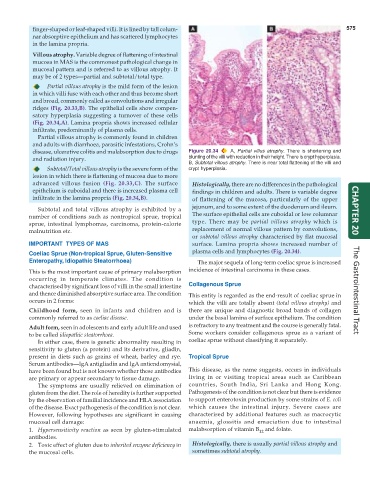
                 Partial villous atrophy is the mild form of the lesion
            in which villi fuse with each other and thus become short
            and broad, commonly called as convolutions and irregular
            ridges (Fig. 20.33,B). The epithelial cells show compen-
            satory hyperplasia suggesting a turnover of these cells
            (Fig. 20.34,A). Lamina propria shows increased cellular
            infiltrate, predominantly of plasma cells.
              Partial villous atrophy is commonly found in children
            and adults with diarrhoea, parasitic infestations, Crohn’s
            disease, ulcerative colitis and malabsorption due to drugs  Figure 20.34  A,  Partial villus atrophy. There is shortening and
            and radiation injury.                              blunting of the villi with reduction in their height. There is crypt hyperplasia.
                                                               B, Subtotal villous atrophy. There is near total flattening of the villi and
                 Subtotal/Total villous atrophy is the severe form of the  crypt hyperplasia.
            lesion in which there is flattening of mucosa due to more
            advanced villous fusion  (Fig. 20.33,C). The surface  Histologically, there are no differences in the pathological
            epithelium is cuboidal and there is increased plasma cell  findings in children and adults. There is variable degree
            infiltrate in the lamina propria (Fig. 20.34,B).     of flattening of the mucosa, particularly of the upper
              Subtotal and total villous atrophy is exhibited by a  jejunum, and to some extent of the duodenum and ileum.  CHAPTER 20
           number of conditions such as nontropical sprue, tropical  The surface epithelial cells are cuboidal or low columnar
           sprue, intestinal lymphomas, carcinoma, protein-calorie  type. There may be  partial villous atrophy which is
           malnutrition etc.                                     replacement of normal villous pattern by convolutions,
                                                                 or subtotal villous atrophy characterised by flat mucosal
           IMPORTANT  TYPES OF MAS                               surface. Lamina propria shows increased number of
           Coeliac Sprue (Non-tropical Sprue, Gluten-Sensitive   plasma cells and lymphocytes (Fig. 20.34).
           Enteropathy, Idiopathic Steatorrhoea)                  The major sequela of long-term coeliac sprue is increased
           This is the most important cause of primary malabsorption  incidence of intestinal carcinoma in these cases.
           occurring in temperate climates. The condition is
           characterised by significant loss of villi in the small intestine  Collagenous Sprue
           and thence diminished absorptive surface area. The condition  This entity is regarded as the end-result of coeliac sprue in  The Gastrointestinal Tract
           occurs in 2 forms:                                  which the villi are totally absent (total villous atrophy) and
           Childhood form, seen in infants and children and is  there are unique and diagnostic broad bands of collagen
           commonly referred to as coeliac disease.            under the basal lamina of surface epithelium. The condition
           Adult form, seen in adolescents and early adult life and used  is refractory to any treatment and the course is generally fatal.
           to be called idiopathic steatorrhoea.               Some workers consider collagenous sprue as a variant of
              In either case, there is genetic abnormality resulting in  coeliac sprue without classifying it separately.
           sensitivity to gluten (a protein) and its derivative, gliadin,
           present in diets such as grains of wheat, barley and rye.  Tropical Sprue
           Serum antibodies—IgA antigliadin and IgA antiendomysial,
           have been found but is not known whether these antibodies  This disease, as the name suggests, occurs in individuals
           are primary or appear secondary to tissue damage.   living in or visiting tropical areas such as Caribbean
              The symptoms are usually relieved on elimination of  countries, South India, Sri Lanka and Hong Kong.
           gluten from the diet. The role of heredity is further supported  Pathogenesis of the condition is not clear but there is evidence
           by the observation of familial incidence and HLA association  to support enterotoxin production by some strains of E. coli
           of the disease. Exact pathogenesis of the condition is not clear.  which causes the intestinal injury. Severe cases are
           However, following hypotheses are significant in causing  characterised by additional features such as macrocytic
           mucosal cell damage:                                anaemia,  glossitis and emaciation due to intestinal
           1. Hypersensitivity reaction as seen by gluten-stimulated  malabsorption of vitamin B  and folate.
                                                                                       12
           antibodies.
           2. Toxic effect of gluten due to inherited enzyme deficiency in  Histologically, there is usually partial villous atrophy and
           the mucosal cells.                                    sometimes subtotal atrophy.

