


Page 594 - Textbook of Pathology, 6th Edition
P. 594
578
            Histologically, appendix has four layers in its wall—
            mucosa, submucosa, muscularis and serosa. The mucosa has
            patchy distribution of crypts and the submucosa has
            abundant lymphoid tissue. Argentaffin and non-
            argentaffin endocrine cells are present in the base of
            mucosal glands just as in the small intestine. The muscu-
            laris of the appendix has two layers (inner circular and
            outer longitudinal) as elsewhere in the alimentary tract.
              Two important diseases involving the appendix are
           appendicitis and appendiceal carcinoids.
           APPENDICITIS
           Acute inflammation of the appendix, acute appendicitis, is
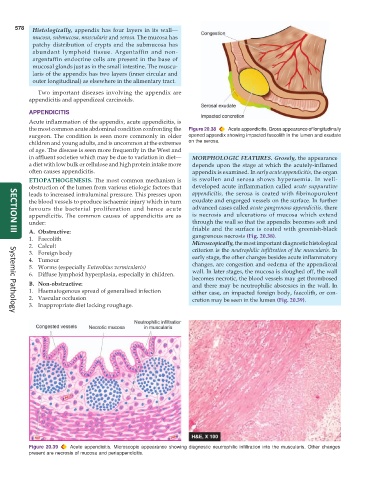
           the most common acute abdominal condition confronting the  Figure 20.38  Acute appendicitis. Gross appearance of longitudinally
           surgeon. The condition is seen more commonly in older  opened appendix showing impacted faecolith in the lumen and exudate
           children and young adults, and is uncommon at the extremes  on the serosa.
           of age. The disease is seen more frequently in the West and
           in affluent societies which may be due to variation in diet—  MORPHOLOGIC FEATURES. Grossly, the appearance
           a diet with low bulk or cellulose and high protein intake more  depends upon the stage at which the acutely-inflamed
           often causes appendicitis.                            appendix is examined. In early acute appendicitis, the organ
           ETIOPATHOGENESIS. The most common mechanism is        is swollen and serosa shows hyperaemia. In well-
           obstruction of the lumen from various etiologic factors that  developed acute inflammation called acute suppurative
           leads to increased intraluminal pressure. This presses upon  appendicitis, the serosa is coated with fibrinopurulent
           the blood vessels to produce ischaemic injury which in turn  exudate and engorged vessels on the surface. In further
           favours the bacterial proliferation and hence acute   advanced cases called acute gangrenous appendicitis, there
           appendicitis. The common causes of appendicitis are as  is necrosis and ulcerations of mucosa which extend
           under:                                                through the wall so that the appendix becomes soft and
           A. Obstructive:                                       friable and the surface is coated with greenish-black
     SECTION III
           1. Faecolith                                          gangrenous necrosis (Fig. 20.38).
           2. Calculi                                            Microscopically, the most important diagnostic histological
           3. Foreign body                                       criterion is the neutrophilic infiltration of the muscularis. In
           4. Tumour                                             early stage, the other changes besides acute inflammatory
                                                                 changes, are congestion and oedema of the appendiceal
           5. Worms (especially Enterobius vermicularis)         wall. In later stages, the mucosa is sloughed off, the wall
           6. Diffuse lymphoid hyperplasia, especially in children.
                                                                 becomes necrotic, the blood vessels may get thrombosed
           B. Non-obstructive:                                   and there may be neutrophilic abscesses in the wall. In
           1. Haematogenous spread of generalised infection      either case, an impacted foreign body, faecolith, or con-
           2. Vascular occlusion                                 cretion may be seen in the lumen (Fig. 20.39).
           3. Inappropriate diet lacking roughage.
     Systemic Pathology


           Figure 20.39  Acute appendicitis. Microscopic appearance showing diagnostic neutrophilic infiltration into the muscularis. Other changes
           present are necrosis of mucosa and periappendicitis.

