


Page 600 - Textbook of Pathology, 6th Edition
P. 600
584


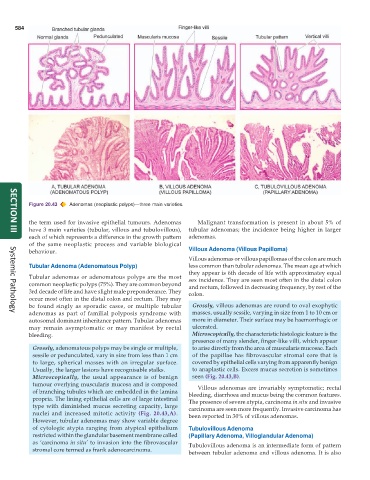
           Figure 20.43  Adenomas (neoplastic polyps)—three main varieties.

           the term used for invasive epithelial tumours. Adenomas  Malignant transformation is present in about 5% of
           have 3 main varieties (tubular, villous and tubulovillous),  tubular adenomas; the incidence being higher in larger
     SECTION III
           each of which represents a difference in the growth pattern  adenomas.
           of the same neoplastic process and variable biological
           behaviour.                                          Villous Adenoma (Villous Papilloma)
                                                               Villous adenomas or villous papillomas of the colon are much
           Tubular Adenoma (Adenomatous Polyp)                 less common than tubular adenomas. The mean age at which
                                                               they appear is 6th decade of life with approximatey equal
           Tubular adenomas or adenomatous polyps are the most  sex incidence. They are seen most often in the distal colon
           common neoplastic polyps (75%). They are common beyond  and rectum, followed in decreasing frequency, by rest of the
           3rd decade of life and have slight male preponderance. They  colon.
           occur most often in the distal colon and rectum. They may
           be found singly as sporadic cases, or multiple tubular  Grossly, villous adenomas are round to oval exophytic
           adenomas as part of familial polyposis syndrome with  masses, usually sessile, varying in size from 1 to 10 cm or
     Systemic Pathology
           autosomal dominant inheritance pattern. Tubular adenomas  more in diameter. Their surface may be haemorrhagic or
           may remain asymptomatic or may manifest by rectal     ulcerated.
           bleeding.                                             Microscopically, the characteristic histologic feature is the
                                                                 presence of many slender, finger-like villi, which appear
            Grossly, adenomatous polyps may be single or multiple,  to arise directly from the area of muscularis mucosae. Each
            sessile or pedunculated, vary in size from less than 1 cm  of the papillae has fibrovascular stromal core that is
            to large, spherical masses with an irregular surface.  covered by epithelial cells varying from apparently benign
            Usually, the larger lesions have recognisable stalks.  to anaplastic cells. Excess mucus secretion is sometimes
            Microscopically, the usual appearance is of benign   seen (Fig. 20.43,B).
            tumour overlying muscularis mucosa and is composed    Villous adenomas are invariably symptomatic; rectal
            of branching tubules which are embedded in the lamina  bleeding, diarrhoea and mucus being the common features.
            propria. The lining epithelial cells are of large intestinal  The presence of severe atypia, carcinoma in situ and invasive
            type with diminished mucus secreting capacity, large  carcinoma are seen more frequently. Invasive carcinoma has
            nuclei and increased mitotic activity  (Fig. 20.43,A).  been reported in 30% of villous adenomas.
            However, tubular adenomas may show variable degree
            of cytologic atypia ranging from atypical epithelium  Tubulovillous Adenoma
            restricted within the glandular basement membrane called  (Papillary Adenoma, Villoglandular Adenoma)
            as ‘carcinoma in situ’ to invasion into the fibrovascular  Tubulovillous adenoma is an intermediate form of pattern
            stromal core termed as frank adenocarcinoma.
                                                               between tubular adenoma and villous adenoma. It is also

