


Page 601 - Textbook of Pathology, 6th Edition
P. 601
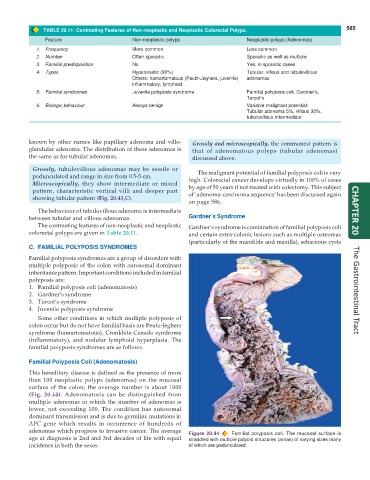
TABLE 20.11: Contrasting Features of Non-neoplastic and Neoplastic Colorectal Polyps. 585
Feature Non-neoplastic polyps Neoplastic polyps (Adenomas)
1. Frequency More common Less common
2. Number Often sporadic Sporadic as well as multiple
3. Familial predisposition No Yes, in sporadic cases
4. Types Hyperplastic (90%) Tubular, villous and tubulovillous
Others: hamartomatous (Peutz-Jeghers, juvenile) adenomas
inflammatory, lymphoid
5. Familial syndromes Juvenile polyposis syndrome Familial polyposis coli, Gardner’s,
Turcot’s
6. Biologic behaviour Always benign Variable malignant potential:
Tubular adenoma 5%, villous 30%,
tubulovillous intermediate
known by other names like papillary adenoma and villo- Grossly and microscopically, the commonest pattern is
glandular adenoma. The distribution of these adenomas is that of adenomatous polyps (tubular adenomas)
the same as for tubular adenomas. discussed above.
Grossly, tubulovillous adenomas may be sessile or The malignant potential of familial polyposis coli is very
pedunculated and range in size from 0.5-5 cm. high. Colorectal cancer develops virtually in 100% of cases
Microscopically, they show intermediate or mixed by age of 50 years if not treated with colectomy. This subject
pattern, characteristic vertical villi and deeper part of ‘adenoma-carcinoma sequence’ has been discussed again
showing tubular pattern (Fig. 20.43,C).
on page 586.
The behaviour of tubulovillous adenoma is intermediate CHAPTER 20
between tubular and villous adenomas. Gardner’s Syndrome
The contrasting features of non-neoplastic and neoplastic Gardner’s syndrome is combination of familial polyposis coli
colorectal polyps are given in Table 20.11. and certain extra-colonic lesions such as multiple osteomas
(particularly of the mandible and maxilla), sebaceous cysts
C. FAMILIAL POLYPOSIS SYNDROMES
Familial polyposis syndromes are a group of disorders with
multiple polyposis of the colon with autosomal dominant
inheritance pattern. Important conditions included in familial
polyposis are:
1. Familial polyposis coli (adenomatosis)
2. Gardner’s syndrome The Gastrointestinal Tract
3. Turcot’s syndrome
4. Juvenile polyposis syndrome
Some other conditions in which multiple polyposis of
colon occur but do not have familial basis are Peutz-Jeghers
syndrome (hamartomatous), Cronkhite-Canada syndrome
(inflammatory), and nodular lymphoid hyperplasia. The
familial polyposis syndromes are as follows.
Familial Polyposis Coli (Adenomatosis)
This hereditary disease is defined as the presence of more
than 100 neoplastic polyps (adenomas) on the mucosal
surface of the colon; the average number is about 1000
(Fig. 20.44). Adenomatosis can be distinguished from
multiple adenomas in which the number of adenomas is
fewer, not exceeding 100. The condition has autosomal
dominant transmission and is due to germline mutations in
APC gene which results in occurrence of hundreds of
adenomas which progress to invasive cancer. The average Figure 20.44 Familial polyposis coli. The mucosal surface is
age at diagnosis is 2nd and 3rd decades of life with equal straddled with multiple polyoid structures (arrow) of varying sizes many
incidence in both the sexes. of which are pedunculated.

