


Page 603 - Textbook of Pathology, 6th Edition
P. 603
587


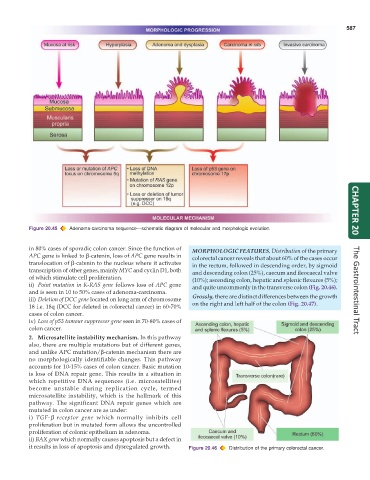
           Figure 20.45  Adenoma-carcinoma sequence—schematic diagram of molecular and morphologic evolution.         CHAPTER 20


           in 80% cases of sporadic colon cancer. Since the function of  MORPHOLOGIC FEATURES. Distribution of the primary
           APC gene is linked to β-catenin, loss of APC gene results in  colorectal cancer reveals that about 60% of the cases occur
           translocation of β-catenin to the nucleus where it activates  in the rectum, followed in descending order, by sigmoid
           transcription of other genes, mainly MYC and cyclin D1, both  and descending colon (25%), caecum and ileocaecal valve
           of which stimulate cell proliferation.                (10%); ascending colon, hepatic and splenic flexures (5%);
           ii) Point mutation in K-RAS gene follows loss of APC gene  and quite uncommonly in the transverse colon (Fig. 20.46).
           and is seen in 10 to 50% cases of adenoma-carcinoma.                                                       The Gastrointestinal Tract
           iii) Deletion of DCC gene located on long arm of chromosome  Grossly, there are distinct differences between the growth
           18 i.e. 18q (DCC for deleted in colorectal cancer) in 60-70%  on the right and left half of the colon (Fig. 20.47).
           cases of colon cancer.
           iv) Loss of p53 tumour suppressor gene seen in 70-80% cases of
           colon cancer.
           2. Microsatellite instability mechanism. In this pathway
           also, there are multiple mutations but of different genes,
           and unlike APC mutation/β-catenin mechanism there are
           no morphologically identifiable changes. This pathway
           accounts for 10-15% cases of colon cancer. Basic mutation
           is loss of DNA repair gene. This results in a situation in
           which repetitive DNA sequences (i.e. microsatellites)
           become unstable during replication cycle, termed
           microsatellite instability, which is the hallmark of this
           pathway. The significant DNA repair genes which are
           mutated in colon cancer are as under:
           i)  TGF-β receptor  gene  which normally inhibits cell
           proliferation but in mutated form allows the uncontrolled
           proliferation of colonic epithelium in adenoma.
           ii) BAX gene which normally causes apoptosis but a defect in
           it results in loss of apoptosis and dysregulated growth.  Figure 20.46  Distribution of the primary colorectal cancer.

