


Page 605 - Textbook of Pathology, 6th Edition
P. 605
589


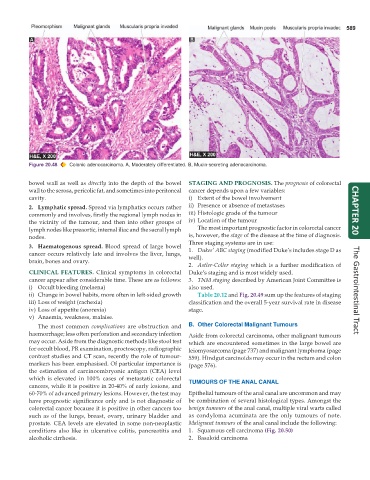
           Figure 20.48  Colonic adenocarcinoma. A, Moderately differentiated. B, Mucin-secreting adenocarcinoma.


           bowel wall as well as directly into the depth of the bowel  STAGING AND PROGNOSIS. The prognosis of colorectal
           wall to the serosa, pericolic fat, and sometimes into peritoneal  cancer depends upon a few variables:
           cavity.                                             i) Extent of the bowel involvement
           2. Lymphatic spread. Spread via lymphatics occurs rather  ii) Presence or absence of metastases
           commonly and involves, firstly the regional lymph nodes in  iii) Histologic grade of the tumour            CHAPTER 20
           the vicinity of the tumour, and then into other groups of  iv) Location of the tumour
           lymph nodes like preaortic, internal iliac and the sacral lymph  The most important prognostic factor in colorectal cancer
           nodes.                                              is, however, the stage of the disease at the time of diagnosis.
                                                               Three staging systems are in use:
           3. Haematogenous spread. Blood spread of large bowel  1. Dukes’ ABC staging (modified Duke’s includes stage D as
           cancer occurs relatively late and involves the liver, lungs,  well).
           brain, bones and ovary.
                                                               2. Astler-Coller staging which is a further modification of
           CLINICAL FEATURES.  Clinical symptoms in colorectal  Duke’s staging and is most widely used.
           cancer appear after considerable time. These are as follows:  3. TNM staging described by American Joint Committee is
           i) Occult bleeding (melaena)                        also used.
           ii) Change in bowel habits, more often in left-sided growth  Table 20.12 and Fig. 20.49 sum up the features of staging  The Gastrointestinal Tract
           iii) Loss of weight (cachexia)                      classification and the overall 5-year survival rate in disease
           iv) Loss of appetite (anorexia)                     stage.
           v) Anaemia, weakness, malaise.
              The most common  complications are obstruction and  B. Other Colorectal Malignant Tumours
           haemorrhage; less often perforation and secondary infection  Aside from colorectal carcinoma, other malignant tumours
           may occur. Aside from the diagnostic methods like stool test  which are encountered sometimes in the large bowel are
           for occult blood, PR examination, proctoscopy, radiographic  leiomyosarcoma (page 737) and malignant lymphoma (page
           contrast studies and CT scan, recently the role of tumour-  559). Hindgut carcinoids may occur in the rectum and colon
           markers has been emphasised. Of particular importance is  (page 576).
           the estimation of carcinoembryonic antigen (CEA) level
           which is elevated in 100% cases of metastatic colorectal  TUMOURS OF THE ANAL CANAL
           cancers, while it is positive in 20-40% of early lesions, and
           60-70% of advanced primary lesions. However, the test may  Epithelial tumours of the anal canal are uncommon and may
           have prognostic significance only and is not diagnostic of  be combination of several histological types. Amongst the
           colorectal cancer because it is positive in other cancers too  benign tumours of the anal canal, multiple viral warts called
           such as of the lungs, breast, ovary, urinary bladder and  as condyloma acuminata are the only tumours of note.
           prostate. CEA levels are elevated in some non-neoplastic  Malignant tumours of the anal canal include the following:
           conditions also like in ulcerative colitis, pancreatitis and  1. Squamous cell carcinoma (Fig. 20.50)
           alcoholic cirrhosis.                                2. Basaloid carcinoma

