


Page 606 - Textbook of Pathology, 6th Edition
P. 606
590


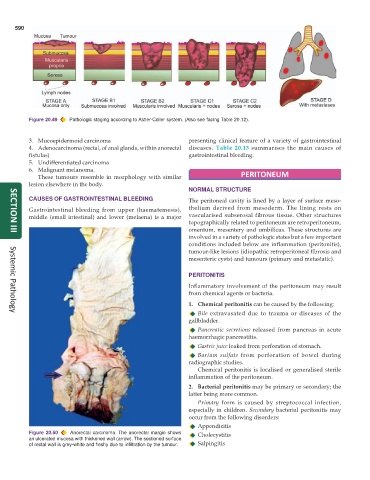
           Figure 20.49  Pathologic staging according to Astler-Coller system. (Also see facing Table 20.12).


           3. Mucoepidermoid carcinoma                         presenting clinical feature of a variety of gastrointestinal
           4. Adenocarcinoma (rectal, of anal glands, within anorectal  diseases.  Table 20.13  summarises the main causes of
           fistulas)                                           gastrointestinal bleeding.
           5. Undifferentiated carcinoma
           6. Malignant melanoma.
              These tumours resemble in morphology with similar                  PERITONEUM
           lesion elsewhere in the body.
                                                               NORMAL STRUCTURE
           CAUSES OF GASTROINTESTINAL BLEEDING                 The peritoneal cavity is lined by a layer of surface meso-
           Gastrointestinal bleeding from upper (haematemesis),  thelium derived from mesoderm. The lining rests on
           middle (small intestinal) and lower (melaena) is a major  vascularised subserosal fibrous tissue. Other structures
                                                               topographically related to peritoneum are retroperitoneum,
                                                               omentum, mesentery and umbilicus. These structures are
     SECTION III
                                                               involved in a variety of pathologic states but a few important
                                                               conditions included below are inflammation (peritonitis),
                                                               tumour-like lesions (idiopathic retroperitoneal fibrosis and
                                                               mesenteric cysts) and tumours (primary and metastatic).

                                                               PERITONITIS
                                                               Inflammatory involvement of the peritoneum may result
                                                               from chemical agents or bacteria.
                                                               1. Chemical peritonitis can be caused by the following:
                                                                  Bile extravasated due to trauma or diseases of the
     Systemic Pathology
                                                               gallbladder.
                                                                  Pancreatic secretions released from pancreas in acute
                                                               haemorrhagic pancreatitis.
                                                                  Gastric juice leaked from perforation of stomach.
                                                                  Barium sulfate from perforation of bowel during
                                                               radiographic studies.
                                                                  Chemical peritonitis is localised or generalised sterile
                                                               inflammation of the peritoneum.
                                                               2. Bacterial peritonitis may be primary or secondary; the
                                                               latter being more common.
                                                                  Primary form is caused by streptococcal infection,
                                                               especially in children.  Secondary bacterial peritonitis may
                                                               occur from the following disorders:
                                                                  Appendicitis
           Figure 20.50  Anorectal carcinoma. The anorectal margin shows  Cholecystitis
           an ulcerated mucosa with thickened wall (arrow). The sectioned surface
           of rectal wall is grey-white and fleshy due to infiltration by the tumour.  Salpingitis

