


Page 608 - Textbook of Pathology, 6th Edition
P. 608
592

                                            The Liver, Biliary Tract and
            Chapter 21
            Chapter 21
                                                     Exocrine Pancreas


                                 LIVER


           NORMAL STRUCTURE
           ANATOMY.  The liver is the largest organ in the body
           weighing 1400-1600 gm in the males and 1200-1400 gm in
           the females. There are 2 main anatomical lobes—right and
           left, the right being about six times the size of the left lobe.
           The right lobe has quadrate lobe on its inferior surface and a
           caudate lobe on the posterior surface. The right and left lobes
           are separated anteriorly by a fold of peritoneum called the
           falciform ligament, inferiorly by the fissure for the ligamentum
           teres, and posteriorly by the fissure for the  ligamentum
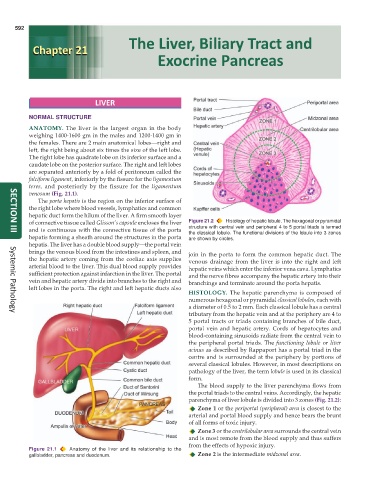
           venosum (Fig. 21.1).
              The porta hepatis is the region on the inferior surface of
           the right lobe where blood vessels, lymphatics and common
           hepatic duct form the hilum of the liver. A firm smooth layer
           of connective tissue called Glisson’s capsule encloses the liver  Figure 21.2  Histology of hepatic lobule. The hexagonal or pyramidal
           and is continuous with the connective tissue of the porta  structure with central vein and peripheral 4 to 5 portal triads is termed
                                                               the classical lobule. The functional divisions of the lobule into 3 zones
     SECTION III
           hepatis forming a sheath around the structures in the porta  are shown by circles.
           hepatis. The liver has a double blood supply—the portal vein
           brings the venous blood from the intestines and spleen, and  join in the porta to form the common hepatic duct. The
           the hepatic artery coming from the coeliac axis supplies  venous drainage from the liver is into the right and left
           arterial blood to the liver. This dual blood supply provides  hepatic veins which enter the inferior vena cava. Lymphatics
           sufficient protection against infarction in the liver. The portal  and the nerve fibres accompany the hepatic artery into their
           vein and hepatic artery divide into branches to the right and  branchings and terminate around the porta hepatis.
           left lobes in the porta. The right and left hepatic ducts also
                                                               HISTOLOGY.  The hepatic parenchyma is composed of
                                                               numerous hexagonal or pyramidal classical lobules, each with
                                                               a diameter of 0.5 to 2 mm. Each classical lobule has a central
                                                               tributary from the hepatic vein and at the periphery are 4 to
     Systemic Pathology
                                                               5 portal tracts or triads containing branches of bile duct,
                                                               portal vein and hepatic artery. Cords of hepatocytes and
                                                               blood-containing sinusoids radiate from the central vein to
                                                               the peripheral portal triads. The functioning lobule or liver
                                                               acinus as described by Rappaport has a portal triad in the
                                                               centre and is surrounded at the periphery by portions of
                                                               several classical lobules. However, in most descriptions on
                                                               pathology of the liver, the term lobule is used in its classical
                                                               form.
                                                                  The blood supply to the liver parenchyma flows from
                                                               the portal triads to the central veins. Accordingly, the hepatic
                                                               parenchyma of liver lobule is divided into 3 zones (Fig. 21.2):
                                                                  Zone 1 or the periportal (peripheral) area is closest to the
                                                               arterial and portal blood supply and hence bears the brunt
                                                               of all forms of toxic injury.
                                                                  Zone 3 or the centrilobular area surrounds the central vein
                                                               and is most remote from the blood supply and thus suffers
                                                               from the effects of hypoxic injury.
           Figure 21.1  Anatomy of the liver and its relationship to the
           gallbladder, pancreas and duodenum.                    Zone 2 is the intermediate midzonal area.

