


Page 610 - Textbook of Pathology, 6th Edition
P. 610
594
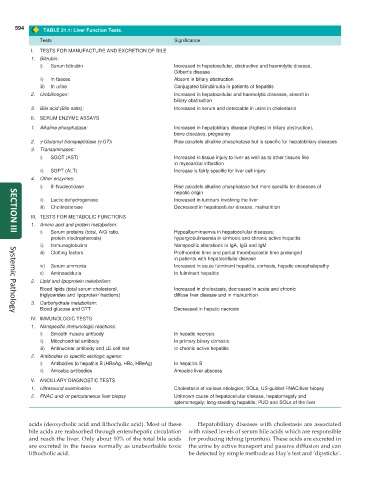
TABLE 21.1: Liver Function Tests.
Tests Significance
I. TESTS FOR MANUFACTURE AND EXCRETION OF BILE
1. Bilirubin:
i) Serum bilirubin Increased in hepatocellular, obstructive and haemolytic disease,
Gilbert’s disease
ii) In faeces Absent in biliary obstruction
iii) In urine Conjugated bilirubinuria in patients of hepatitis
2. Urobilinogen: Increased in hepatocellular and haemolytic diseases, absent in
biliary obstruction
3. Bile acid (Bile salts): Increased in serum and detectable in urine in cholestasis
II. SERUM ENZYME ASSAYS
1. Alkaline phosphatase: Increased in hepatobiliary disease (highest in biliary obstruction),
bone diseases, pregnancy
2. γ-Glutamyl transpeptidase (γ-GT): Rise parallels alkaline phosphatase but is specific for hepatobiliary diseases
3. Transaminases:
i) SGOT (AST) Increased in tissue injury to liver as well as to other tissues like
in myocardial infarction
ii) SGPT (ALT) Increase is fairly specific for liver cell injury
4. Other enzymes:
i) 5'-Nucleotidase Rise parallels alkaline phosphatase but more specific for diseases of
hepatic origin
ii) Lactic dehydrogenase Increased in tumours involving the liver
iii) Cholinesterase Decreased in hepatocellular disease, malnutrition
III. TESTS FOR METABOLIC FUNCTIONS
1. Amino acid and protein metabolism:
i) Serum proteins (total, A/G ratio, Hypoalbuminaemia in hepatocellular diseases;
SECTION III
protein electrophoresis) hyperglobulinaemia in cirrhosis and chronic active hepatitis
ii) Immunoglobulins Nonspecific alterations in IgA, IgG and IgM
iii) Clotting factors Prothrombin time and partial thromboplastin time prolonged
in patients with hepatocellular disease
iv) Serum ammonia Increased in acute fulminant hepatitis, cirrhosis, hepatic encephalopathy
v) Aminoaciduria In fulminant hepatitis
2. Lipid and lipoprotein metabolism:
Blood lipids (total serum cholesterol, Increased in cholestasis, decreased in acute and chronic
triglycerides and lipoprotein fractions) diffuse liver disease and in malnutrition
3. Carbohydrate metabolism:
Blood glucose and GTT Decreased in hepatic necrosis
Systemic Pathology
IV. IMMUNOLOGIC TESTS
1. Nonspecific immunologic reactions:
i) Smooth muscle antibody In hepatic necrosis
ii) Mitochondrial antibody In primary biliary cirrhosis
iii) Antinuclear antibody and LE cell test In chronic active hepatitis
2. Antibodies to specific etiologic agents:
i) Antibodies to hepatitis B (HBsAg, HBc, HBeAg) In hepatitis B
ii) Amoeba antibodies Amoebic liver abscess
V. ANCILLARY DIAGNOSTIC TESTS
1. Ultrasound examination Cholestasis of various etiologies; SOLs, US-guided-FNAC/liver biopsy
2. FNAC and/ or percutaneous liver biopsy Unknown cause of hepatocellular disease, hepatomegaly and
splenomegaly; long-standing hepatitis; PUO and SOLs of the liver
acids (deoxycholic acid and lithocholic acid). Most of these Hepatobiliary diseases with cholestasis are associated
bile acids are reabsorbed through enterohepatic circulation with raised levels of serum bile acids which are responsible
and reach the liver. Only about 10% of the total bile acids for producing itching (pruritus). These acids are excreted in
are excreted in the faeces normally as unabsorbable toxic the urine by active transport and passive diffusion and can
lithocholic acid. be detected by simple methods as Hay’s test and ‘dipsticks’.

