


Page 613 - Textbook of Pathology, 6th Edition
P. 613
erythrocytes at the end of their normal lifespan of 120 days                                             597
           takes place in the reticuloendothelial system in the bone
           marrow, spleen and liver. The remaining 15-20% of the
           bilirubin comes partly from non-haemoglobin haem-
           containing pigments such as myoglobin, catalase and
           cytochromes, and partly from ineffective erythropoiesis. In
           either case, haem moiety is formed which is converted to
           biliverdin by microsomal haem oxygenase for which oxygen
           and NADPH are essential requirements. Bilirubin is formed
           from biliverdin by biliverdin reductase.
           2. TRANSPORT OF BILIRUBIN. Bilirubin on release from
           macrophages circulates as unconjugated bilirubin in plasma
           tightly bound to albumin. Certain drugs such as
           sulfonamides and salicylates compete with bilirubin for
           albumin binding and displace bilirubin from albumin, thus
           facilitating bilirubin to enter into the brain in neonates and
           increase the risk of kernicterus. Bilirubin is found in body
           fluids in proportion to their albumin content such as in CSF,
           joint effusions, cysts etc.
           3. HEPATIC PHASE.  On coming in contact with the
           hepatocyte surface, unconjugated bilirubin is preferentially
           metabolised which involves 3 steps: hepatic uptake,
           conjugation and secretion in bile.
           i) Hepatic uptake: Albumin-bound unconjugated bilirubin
           upon entry into the hepatocyte, is dissociated into bilirubin                                              CHAPTER 21
           and albumin. The bilirubin gets bound to cytoplasmic protein
           glutathione-S-transferase (GST) (earlier called ligandin).
           ii) Conjugation: Unconjugated bilirubin is not water-soluble
           but is alcohol-soluble and is converted into water-soluble
           compound by conjugation. Conjugation occurs in
           endoplasmic reticulum and involves conversion to bilirubin
           mono- and diglucuronide by the action of microsomal
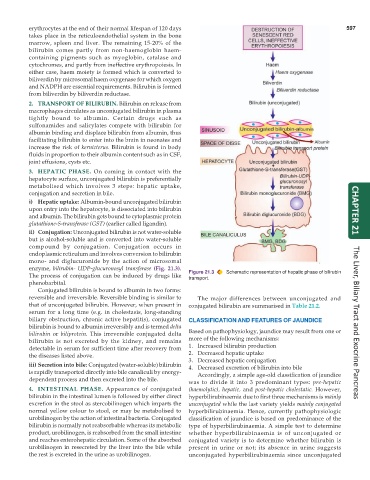
           enzyme, bilirubin- UDP-glucuronosyl transferase  (Fig. 21.3).
           The process of conjugation can be induced by drugs like  Figure 21.3  Schematic representation of hepatic phase of bilirubin
                                                               transport.
           phenobarbital.
              Conjugated bilirubin is bound to albumin in two forms:
           reversible and irreversible. Reversible binding is similar to  The major differences between unconjugated and
           that of unconjugated bilirubin. However, when present in  conjugated bilirubin are summarised in Table 21.2.
           serum for a long time (e.g. in cholestasis, long-standing
           biliary obstruction, chronic active hepatitis), conjugated  CLASSIFICATION AND FEATURES OF JAUNDICE
           bilirubin is bound to albumin irreversibly and is termed delta                                             The Liver, Biliary Tract and Exocrine Pancreas
           bilirubin or  biliprotein. This irreversible conjugated delta  Based on pathophysiology, jaundice may result from one or
           bilirubin is not excreted by the kidney, and remains  more of the following mechanisms:
           detectable in serum for sufficient time after recovery from  1. Increased bilirubin production
           the diseases listed above.                          2. Decreased hepatic uptake
                                                               3. Decreased hepatic conjugation
           iii) Secretion into bile: Conjugated (water-soluble) bilirubin  4. Decreased excretion of bilirubin into bile
           is rapidly transported directly into bile canaliculi by energy-  Accordingly, a simple age-old classification of jaundice
           dependent process and then excreted into the bile.
                                                               was to divide it into 3 predominant types:  pre-hepatic
           4. INTESTINAL PHASE.  Appearance of conjugated      (haemolytic), hepatic, and post-hepatic cholestatic. However,
           bilirubin in the intestinal lumen is followed by either direct  hyperbilirubinaemia due to first three mechanisms is mainly
           excretion in the stool as stercobilinogen which imparts the  unconjugated while the last variety yields mainly conjugated
           normal yellow colour to stool, or may be metabolised to  hyperbilirubinaemia. Hence, currently pathophysiologic
           urobilinogen by the action of intestinal bacteria. Conjugated  classification of jaundice is based on predominance of the
           bilirubin is normally not reabsorbable whereas its metabolic  type of hyperbilirubinaemia. A simple test to determine
           product, urobilinogen, is reabsorbed from the small intestine  whether hyperbilirubinaemia is of unconjugated or
           and reaches enterohepatic circulation. Some of the absorbed  conjugated variety is to determine whether bilirubin is
           urobilinogen in resecreted by the liver into the bile while  present in urine or not; its absence in urine suggests
           the rest is excreted in the urine as urobilinogen.  unconjugated hyperbilirubinaemia since unconjugated

