


Page 615 - Textbook of Pathology, 6th Edition
P. 615
599


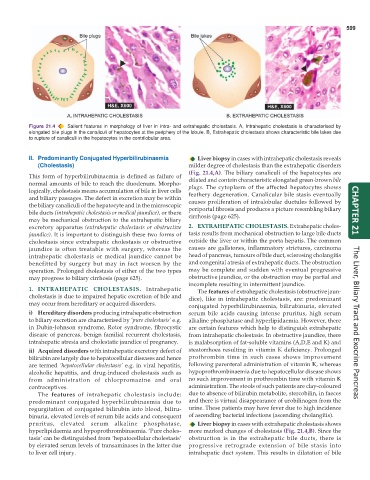
           Figure 21.4  Salient features in morphology of liver in intra- and extrahepatic cholestasis. A, Intrahepatic cholestasis is characterised by
           elongated bile plugs in the canaliculi of hepatocytes at the periphery of the lobule. B, Extrahepatic cholestasis shows characteristic bile lakes due
           to rupture of canaliculi in the hepatocytes in the centrilobular area.


           II. Predominantly Conjugated Hyperbilirubinaemia       Liver biopsy in cases with intrahepatic cholestasis reveals
              (Cholestasis)                                    milder degree of cholestasis than the extrahepatic disorders
                                                               (Fig. 21.4,A). The biliary canaliculi of the hepatocytes are
           This form of hyperbilirubinaemia is defined as failure of
           normal amounts of bile to reach the duodenum. Morpho-  dilated and contain characteristic elongated green-brown bile
                                                               plugs. The cytoplasm of the affected hepatocytes shows
           logically, cholestasis means accumulation of bile in liver cells  feathery degeneration. Canalicular bile stasis eventually
           and biliary passages. The defect in excretion may be within  causes proliferation of intralobular ductules followed by
           the biliary canaliculi of the hepatocyte and in the microscopic  periportal fibrosis and produces a picture resembling biliary
           bile ducts (intrahepatic cholestasis or medical jaundice), or there  cirrhosis (page 625).                 CHAPTER 21
           may be mechanical obstruction to the extrahepatic biliary
           excretory apparatus  (extrahepatic cholestasis or obstructive  2. EXTRAHEPATIC CHOLESTASIS. Extrahepatic choles-
           jaundice). It is important to distinguish these two forms of  tasis results from mechanical obstruction to large bile ducts
           cholestasis since extrahepatic cholestasis or obstructive  outside the liver or within the porta hepatis. The common
           jaundice is often treatable with surgery, whereas the  causes are gallstones, inflammatory strictures, carcinoma
           intrahepatic cholestasis or medical jaundice cannot be  head of pancreas, tumours of bile duct, sclerosing cholangitis
           benefitted by surgery but may in fact worsen by the  and congenital atresia of extrahepatic ducts. The obstruction
           operation. Prolonged cholestasis of either of the two types  may be complete and sudden with eventual progressive
           may progress to biliary cirrhosis (page 625).       obstructive jaundice, or the obstruction may be partial and
                                                               incomplete resulting in intermittent jaundice.
           1. INTRAHEPATIC CHOLESTASIS.  Intrahepatic             The features of extrahepatic cholestasis (obstructive jaun-
           cholestasis is due to impaired hepatic excretion of bile and  dice), like in intrahepatic cholestasis, are: predominant
           may occur from hereditary or acquired disorders.    conjugated hyperbilirubinaemia, bilirubinuria, elevated
           i) Hereditary disorders producing intrahepatic obstruction  serum bile acids causing intense pruritus, high serum
           to biliary excretion are characterised by ‘pure cholestasis’ e.g.  alkaline phosphatase and hyperlipidaemia. However, there
           in Dubin-Johnson syndrome, Rotor syndrome, fibrocystic  are certain features which help to distinguish extrahepatic  The Liver, Biliary Tract and Exocrine Pancreas
           disease of pancreas, benign familial recurrent cholestasis,  from intrahepatic cholestasis. In obstructive jaundice, there
           intrahepatic atresia and cholestatic jaundice of pregnancy.  is malabsorption of fat-soluble vitamins (A,D,E and K) and
           ii) Acquired disorders with intrahepatic excretory defect of  steatorrhoea resulting in vitamin K deficiency. Prolonged
           bilirubin are largely due to hepatocellular diseases and hence  prothrombin time in such cases shows improvement
           are termed  ‘hepatocellular cholestasis’ e.g. in viral hepatitis,  following parenteral administration of vitamin K, whereas
           alcoholic hepatitis, and drug-induced cholestasis such as  hypoprothrombinaemia due to hepatocellular disease shows
           from administration of chlorpromazine and oral      no such improvement in prothrombin time with vitamin K
           contraceptives.                                     administration. The stools of such patients are clay-coloured
              The features of intrahepatic cholestasis include:  due to absence of bilirubin metabolite, stercobilin, in faeces
           predominant conjugated hyperbilirubinaemia due to   and there is virtual disappearance of urobilinogen from the
           regurgitation of conjugated bilirubin into blood, biliru-  urine. These patients may have fever due to high incidence
           binuria, elevated levels of serum bile acids and consequent  of ascending bacterial infections (ascending cholangitis).
           pruritus, elevated serum alkaline phosphatase,         Liver biopsy in cases with extrahepatic cholestasis shows
           hyperlipidaemia and hypoprothrombinaemia. ‘Pure choles-  more marked changes of cholestasis (Fig. 21.4,B). Since the
           tasis’ can be distinguished from ‘hepatocellular cholestasis’  obstruction is in the extrahepatic bile ducts, there is
           by elevated serum levels of transaminases in the latter due  progressive retrograde extension of bile stasis into
           to liver cell injury.                               intrahepatic duct system. This results in dilatation of bile

