


Page 616 - Textbook of Pathology, 6th Edition
P. 616
600 HEREDITARY NON-HAEMOLYTIC
TABLE 21.4: Causes of Neonatal Jaundice.
HYPERBILIRUBINAEMIAS
A. UNCONJUGATED HYPERBILIRUBINAEMIA
Hereditary non-haemolytic hyperbilirubinaemias are a small
1. Physiologic and prematurity jaundice
2. Haemolytic disease of the newborn and kernicterus (page group of uncommon familial disorders of bilirubin
340) metabolism when haemolytic causes have been excluded.
3. Congenital haemolytic disorders (page 314) The commonest is Gilbert’s syndrome; others are Crigler-
4. Perinatal complications (e.g. haemorrhage, sepsis) Najjar syndrome, Dubin-Johnson syndrome, Rotor’s
5. Gilbert’s syndrome syndrome and benign familial recurrent cholestasis. The
6. Crigler-Najjar syndrome (type I and II) features common to all these conditions are presence of
B. CONJUGATED HYPERBILIRUBINAEMIA icterus but almost normal liver function tests and no well-
defined morphologic changes except in Dubin-Johnson
1. Hereditary (Dubin-Johnson syndrome, Rotor’s syndrome)
2. Infections (e.g. hepatitis B, hepatitis C or non-A non-B hepatitis, syndrome. Gilbert’s syndrome and Crigler-Najjar syndrome
rubella, coxsackievirus, cytomegalovirus, echovirus, herpes are examples of hereditary non-haemolytic unconjugated
simplex, syphilis, toxoplasma, gram-negative sepsis) hyperbilirubinaemia, whereas Dubin-Johnson syndrome,
3. Metabolic (e.g. galactosaemia, alpha-1-antitrypsin deficiency, Rotor’s syndrome and benign familial recurrent cholestasis
cystic fibrosis, Niemann-Pick disease) are conditions with hereditary conjugated hyperbilirubinaemia.
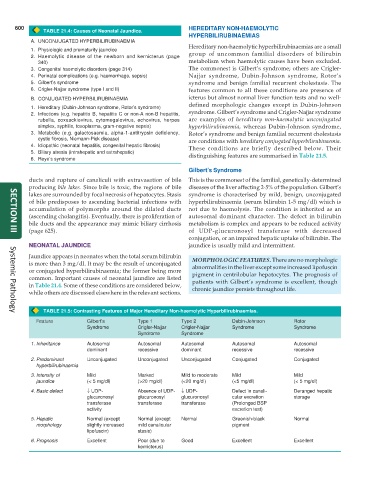
4. Idiopathic (neonatal hepatitis, congenital hepatic fibrosis) These conditions are briefly described below. Their
5. Biliary atresia (intrahepatic and extrahepatic) distinguishing features are summarised in Table 21.5.
6. Reye’s syndrome
Gilbert’s Syndrome
ducts and rupture of canaliculi with extravasation of bile This is the commonest of the familial, genetically-determined
producing bile lakes. Since bile is toxic, the regions of bile diseases of the liver affecting 2-5% of the population. Gilbert’s
lakes are surrounded by focal necrosis of hepatocytes. Stasis syndrome is characterised by mild, benign, unconjugated
of bile predisposes to ascending bacterial infections with hyperbilirubinaemia (serum bilirubin 1-5 mg/dl) which is
accumulation of polymorphs around the dilated ducts not due to haemolysis. The condition is inherited as an
(ascending cholangitis). Eventually, there is proliferation of autosomal dominant character. The defect in bilirubin
bile ducts and the appearance may mimic biliary cirrhosis metabolism is complex and appears to be reduced activity
(page 625). of UDP-glucuronosyl transferase with decreased
SECTION III
conjugation, or an impaired hepatic uptake of bilirubin. The
NEONATAL JAUNDICE jaundice is usually mild and intermittent.
Jaundice appears in neonates when the total serum bilirubin MORPHOLOGIC FEATURES. There are no morphologic
is more than 3 mg/dl. It may be the result of unconjugated abnormalities in the liver except some increased lipofuscin
or conjugated hyperbilirubinaemia; the former being more pigment in centrilobular hepatocytes. The prognosis of
common. Important causes of neonatal jaundice are listed patients with Gilbert’s syndrome is excellent, though
in Table 21.4. Some of these conditions are considered below, chronic jaundice persists throughout life.
while others are discussed elsewhere in the relevant sections.
TABLE 21.5: Contrasting Features of Major Hereditary Non-haemolytic Hyperbilirubinaemias.
Systemic Pathology
Feature Gilbert’s Type 1 Type 2 Dubin-Johnson Rotor
Syndrome Crigler-Najjar Crigler-Najjar Syndrome Syndrome
Syndrome Syndrome
1. Inheritance Autosomal Autosomal Autosomal Autosomal Autosomal
dominant recessive dominant recessive recessive
2. Predominant Unconjugated Unconjugated Unconjugated Conjugated Conjugated
hyperbilirubinaemia
3. Intensity of Mild Marked Mild to moderate Mild Mild
jaundice (< 5 mg/dl) (>20 mg/dl) (<20 mg/dl) (<5 mg/dl) (< 5 mg/dl)
4. Basic defect ↓ UDP- Absence of UDP- ↓ UDP- Defect in canali- Deranged hepatic
glucuronosyl glucuronosyl glucuronosyl cular excretion storage
transferase transferase transferase (Prolonged BSP
activity excretion test)
5. Hepatic Normal (except Normal (except Normal Greenish-black Normal
morphology slightly increased mild canalicular pigment
lipofuscin) stasis)
6. Prognosis Excellent Poor (due to Good Excellent Excellent
kernicterus)

