


Page 619 - Textbook of Pathology, 6th Edition
P. 619
intravascular coagulation (consumption coagulopathy),  603
                                                               thrombocytopenia and presence of fibrin degradation
                                                               products in the blood.
                                                               7. Ascites and oedema. Chronic liver failure due to cirrhosis
                                                               may result in portal hypertension and ascites (page 630).
                                                               Decreased synthesis of albumin by the liver resulting in
                                                               hypoproteinaemia and consequent fall in plasma oncotic
                                                               pressure, increased hydrostatic pressure due to portal
                                                               hypertension and secondary hyperaldosteronism, contribute
                                                               to the development of ascites and oedema in these patients.
                                                               8. Endocrine changes. Endocrine changes may be found in
                                                               association with chronic hepatic failure. The changes are
                                                               more common in alcoholic cirrhosis in active reproductive
                                                               life. In the male, the changes are towards feminisation such
                                                               as gynaecomastia and hypogonadism. In the female, the
                                                               changes are less towards masculinisation but atrophy of
                                                               gonads and breasts occurs. The underlying mechanism
                                                               appears to be changed end-organ sensitiveness to sex
                                                               hormones in cirrhosis.
                                                               9. Skin changes. In alcoholic cirrhosis  ‘arterial spiders’
                                                               having radiating small vessels from a central arteriole are
                                                               frequent in the vascular region drained by superior vena cava
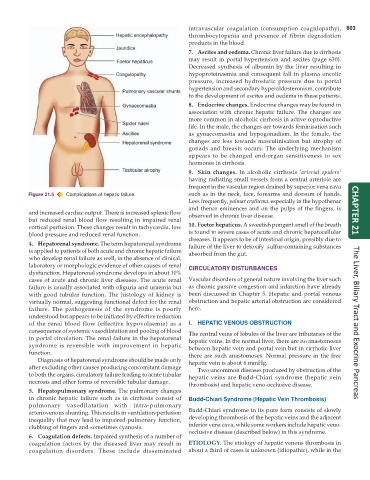
          Figure 21.5  Complications of hepatic failure.       such as in the neck, face, forearms and dorsum of hands.
                                                               Less frequently, palmar erythema, especially in the hypothenar
                                                               and thenar eminences and on the pulps of the fingers, is
           and increased cardiac output. There is increased splenic flow  observed in chronic liver disease.          CHAPTER 21
           but reduced renal blood flow resulting in impaired renal
           cortical perfusion. These changes result in tachycardia, low  10. Foetor hepaticus. A sweetish pungent smell of the breath
           blood pressure and reduced renal function.          is found in severe cases of acute and chronic hepatocellular
                                                               diseases. It appears to be of intestinal origin, possibly due to
           4. Hepatorenal syndrome. The term hepatorenal syndrome  failure of the liver to detoxify  sulfur-containing substances
           is applied to patients of both acute and chronic hepatic failure  absorbed from the gut.
           who develop renal failure as well, in the absence of clinical,
           laboratory or morphologic evidence of other causes of renal  CIRCULATORY DISTURBANCES
           dysfunction. Hepatorenal syndrome develops in about 10%
           cases of acute and chronic liver diseases. The acute renal  Vascular disorders of general nature involving the liver such
           failure is usually associated with oliguria and uraemia but  as chronic passive congestion and infarction have already
           with good tubular function. The histology of kidney is  been discussed in Chapter 5. Hepatic and portal venous
           virtually normal, suggesting functional defect for the renal  obstruction and hepatic arterial obstruction are considered
           failure. The pathogenesis of the syndrome is poorly  here.
           understood but appears to be initiated by effective reduction
           of the renal blood flow (effective hypovolaemia) as a  I.  HEPATIC VENOUS OBSTRUCTION                      The Liver, Biliary Tract and Exocrine Pancreas
           consequence of systemic vasodilatation and pooling of blood  The central veins of lobules of the liver are tributaries of the
           in portal circulation. The renal failure in the hepatorenal  hepatic veins. In the normal liver, there are no anastomoses
           syndrome is reversible with improvement in hepatic  between hepatic vein and portal vein but in cirrhotic liver
           function.                                           there are such anastomoses. Normal pressure in the free
              Diagnosis of hepatorenal syndrome should be made only  hepatic vein is about 6 mmHg.
           after excluding other causes producing concomitant damage  Two uncommon diseases produced by obstruction of the
           to both the organs, circulatory failure leading to acute tubular  hepatic veins are Budd-Chiari syndrome (hepatic vein
           necrosis and other forms of reversible tubular damage.
                                                               thrombosis) and hepatic veno-occlusive disease.
           5. Hepatopulmonary syndrome. The pulmonary changes
           in chronic hepatic failure such as in cirrhosis consist of  Budd-Chiari Syndrome (Hepatic Vein Thrombosis)
           pulmonary vasodilatation with intra-pulmonary
           arteriovenous shunting. This results in ventilation-perfusion  Budd-Chiari syndrome in its pure form consists of slowly
           inequality that may lead to impaired pulmonary function,  developing thrombosis of the hepatic veins and the adjacent
           clubbing of fingers and sometimes cyanosis.         inferior vena cava, while some workers include hepatic veno-
                                                               occlusive disease (described below) in this syndrome.
           6. Coagulation defects. Impaired synthesis of a number of
           coagulation factors by the diseased liver may result in  ETIOLOGY. The etiology of hepatic venous thrombosis in
           coagulation disorders. These include disseminated   about a third of cases is unknown (idiopathic), while in the

