


Page 622 - Textbook of Pathology, 6th Edition
P. 622
606                                                      products, intravenous drug addicts, patients treated by renal
                                                               dialysis and hospital workers exposed to blood, and by
                                                               intimate physical contact such as from mother to child and
                                                               by sexual contact. The disease may occur at any age. HBV
                                                               infection causes more severe form of illness that includes:
                                                               acute hepatitis B, chronic hepatitis, progression to cirrhosis,
                                                               fulminant hepatitis and an asymptomatic carrier stage. HBV
                                                               plays some role in the development of hepatocellular
                                                               carcinoma as discussed later (page 634).

                                                               HEPATITIS B VIRUS (HBV).  The etiologic agent for
                                                               hepatitis B, HBV, is a DNA virus which has been extensively
                                                               studied. Electron microscopic studies on serum of patients
                                                               infected with HBV show 3 forms of viral particles of 2 sizes:
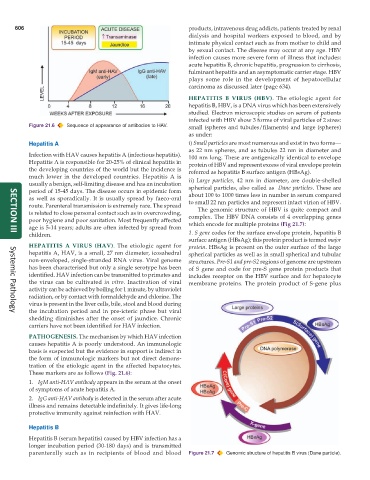
           Figure 21.6  Sequence of appearance of antibodies to HAV.  small (spheres and tubules/filaments) and large (spheres)
                                                               as under:
           Hepatitis A                                         i) Small particles are most numerous and exist in two forms—
                                                               as 22 nm spheres, and as tubules 22 nm in diameter and
           Infection with HAV causes hepatitis A (infectious hepatitis).  100 nm long. These are antigenically identical to envelope
           Hepatitis A is responsible for 20-25% of clinical hepatitis in  protein of HBV and represent excess of viral envelope protein
           the developing countries of the world but the incidence is  referred as hepatitis B surface antigen (HBsAg).
           much lower in the developed countries. Hepatitis A is
           usually a benign, self-limiting disease and has an incubation  ii)  Large particles, 42 nm in diameter,  are double-shelled
           period of 15-45 days. The disease occurs in epidemic form  spherical particles, also called as  Dane particles. These are
           as well as sporadically. It is usually spread by faeco-oral  about 100 to 1000 times less in number in serum compared
           route. Parenteral transmission is extremely rare. The spread  to small 22 nm particles and represent intact virion of HBV.
           is related to close personal contact such as in overcrowding,  The genomic structure of HBV is quite compact and
           poor hygiene and poor sanitation. Most frequently affected  complex. The HBV DNA consists of 4 overlapping genes
           age is 5-14 years; adults are often infected by spread from  which encode for multiple proteins (Fig 21.7):
           children.                                           1. S gene codes for the surface envelope protein, hepatitis B
     SECTION III
                                                               surface antigen (HBsAg); this protein product is termed major
           HEPATITIS A VIRUS (HAV).  The etiologic agent for   protein. HBsAg is present on the outer surface of the large
           hepatitis A, HAV, is a small, 27 nm diameter, icosahedral  spherical particles as well as in small spherical and tubular
           non-enveloped, single-stranded RNA virus. Viral genome  structures. Pre-S1 and pre-S2 regions of genome are upstream
           has been characterised but only a single serotype has been  of S gene and code for pre-S gene protein products that
           identified. HAV infection can be transmitted to primates and  includes receptor on the HBV surface and for hepatocyte
           the virus can be cultivated  in  vitro. Inactivation of viral  membrane proteins. The protein product of S-gene plus
           activity can be achieved by boiling for 1 minute, by ultraviolet
           radiation, or by contact with formaldehyde and chlorine. The
           virus is present in the liver cells, bile, stool and blood during
           the incubation period and in pre-icteric phase but viral
     Systemic Pathology
           shedding diminishes after the onset of jaundice. Chronic
           carriers have not been identified for HAV infection.

           PATHOGENESIS. The mechanism by which HAV infection
           causes hepatitis A is poorly understood. An immunologic
           basis is suspected but the evidence in support is indirect in
           the form of immunologic markers but not direct demons-
           tration of the etiologic agent in the affected hepatocytes.
           These markers are as follows (Fig. 21.6):
           1. IgM anti-HAV antibody appears in the serum at the onset
           of symptoms of acute hepatitis A.
           2. IgG anti-HAV antibody is detected in the serum after acute
           illness and remains detectable indefinitely. It gives life-long
           protective immunity against reinfection with HAV.


           Hepatitis B
           Hepatitis B (serum hepatitis) caused by HBV infection has a
           longer incubation period (30-180 days) and is transmitted
           parenterally such as in recipients of blood and blood  Figure 21.7  Genomic structure of hepatitis B virus (Dane particle).

