


Page 623 - Textbook of Pathology, 6th Edition
P. 623
adjacent pre-S2 region is the middle protein, while the protein                                          607
           products of pre-S1 plus pre-S2 regions is the large protein.
           Large protein coming from both pre-S proteins is rich in
           complete virions.
           2. P gene is the largest and codes for DNA polymerase.
           3. C gene codes for two nucleocapsid proteins, HBeAg and a
           core protein termed HBcAg.
           4. X gene codes for HBxAg which is a small non-particulate
           protein. HbxAg has a role in transactivation the transcription
           of both viral and cellular genes. The processes transactivated
           by X-genes include signal-transduction pathways, increased
           replication of HBV DNA, replication of other viruses
           including HIV, enhanced susceptibility of HBV-infected
           hepatocytes to cytolytic T cells, and pro-apoptotic pathway.
           Expression of HbxAg and its antibodies associated with
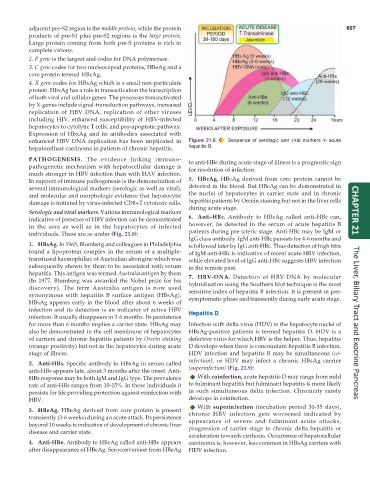
           enhanced HBV DNA replication has been implicated in  Figure 21.8  Sequence of serologic and viral markers in acute
           hepatocelluar carcinoma in patients of chronic hepatitis.  hepatitis B.
           PATHOGENESIS. The evidence linking immuno-          to anti-HBe during acute stage of illness is a prognostic sign
           pathogenetic mechanism with hepatocellular damage is  for resolution of infection.
           much stronger in HBV infection than with HAV infection.
           In support of immune pathogenesis is the demonstration of  5. HBcAg. HBcAg derived from core protein cannot be
           several immunological markers (serologic as well as viral),  detected in the blood. But HBcAg can be demonstrated in
           and molecular and morphologic evidence that hepatocytic  the nuclei of hepatocytes in carrier state and in chronic
           damage is initiated by virus-infected CD8+T cytotoxic cells.  hepatitis patients by Orcein staining but not in the liver cells
                                                               during acute stage.
           Serologic and viral markers. Various immunological markers                                                 CHAPTER 21
           indicative of presence of HBV infection can be demonstrated  6. Anti-HBc. Antibody to HBcAg called anti-HBc can,
           in the sera as well as in the hepatocytes of infected  however, be detected in the serum of acute hepatitis B
           individuals. These are as under (Fig. 21.8):        patients during pre-icteric stage. Anti-HBc may be IgM or
                                                               IgG class antibody. IgM anti-HBc persists for 4-6 months and
           1. HBsAg. In 1965, Blumberg and colleagues in Philadelphia  is followed later by IgG anti-HBc. Thus detection of high titre
           found a lipoprotein complex in the serum of a multiple-  of IgM anti-HBc is indicative of recent acute HBV infection,
           transfused haemophiliac of Australian aborigine which was  while elevated level of IgG anti-HBc suggests HBV infection
           subsequently shown by them to be associated with serum  in the remote past.
           hepatitis. This antigen was termed Australia antigen by them  7. HBV-DNA. Detection of HBV-DNA by molecular
           (In 1977, Blumberg was awarded the Nobel prize for his  hybridisation using the Southern blot technique is the most
           discovery). The term Australia antigen is now used  sensitive index of hepatitis B infection. It is present in pre-
           synonymous with hepatitis B surface antigen (HBsAg).  symptomatic phase and transiently during early acute stage.
           HBsAg appears early in the blood after about 6 weeks of
           infection and its detection is an indicator of active HBV  Hepatitis D
           infection. It usually disappears in 3-6 months. Its persistence
           for more than 6 months implies a carrier state. HBsAg may  Infection with delta virus (HDV) in the hepatocyte nuclei of  The Liver, Biliary Tract and Exocrine Pancreas
           also be demonstrated in the cell membrane of hepatocytes  HBsAg-positive patients is termed hepatitis D. HDV is a
           of carriers and chronic hepatitis patients by Orcein staining  defective virus for which HBV is the helper. Thus, hepatitis
           (orange positivity) but not in the hepatocytes during acute  D develops when there is concomitant hepatitis B infection.
           stage of illness.                                   HDV infection and hepatitis B may be simultaneous (co-
                                                               infection), or HDV may infect a chronic HBsAg carrier
           2. Anti-HBs. Specific antibody to HBsAg in serum called
           anti-HBs appears late, about 3 months after the onset. Anti-  (superinfection) (Fig. 21.9):
           HBs response may be both IgM and IgG type. The prevalence  With coinfection, acute hepatitis D may range from mild
           rate of anti-HBs ranges from 10-15%. In these individuals it  to fulminant hepatitis but fulminant hepatitis is more likely
           persists for life providing protection against reinfection with  in such simultaneous delta infection. Chronicity rarely
           HBV.                                                develops in coinfection.
                                                                  With superinfection (incubation period 30-35 days),
           3. HBeAg. HBeAg derived from core protein is present  chronic HBV infection gets worsened indicated by
           transiently (3-6 weeks) during an acute attack. Its persistence  appearance of severe and fulminant acute attacks,
           beyond 10 weeks is indicative of development of chronic liver  progression of carrier stage to chronic delta hepatitis or
           disease and carrier state.
                                                               acceleration towards cirrhosis. Occurrence of hepatocellular
           4. Anti-HBe. Antibody to HBeAg called anti-HBe appears  carcinoma is, however, less common in HBsAg carriers with
           after disappearance of HBeAg. Seroconversion from HBeAg  HDV infection.

