


Page 624 - Textbook of Pathology, 6th Edition
P. 624
608


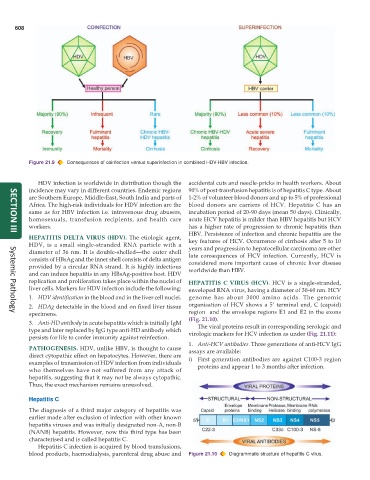
           Figure 21.9  Consequences of coinfection versus superinfection in combined HDV-HBV infection.


              HDV infection is worldwide in distribution though the  accidental cuts and needle-pricks in health workers. About
           incidence may vary in different countries. Endemic regions  90% of post-transfusion hepatitis is of hepatitis C type. About
           are Southern Europe, Middle-East, South India and parts of  1-2% of volunteer blood donors and up to 5% of professional
           Africa. The high-risk individuals for HDV infection are the  blood donors are carriers of HCV. Hepatitis C has an
           same as for HBV infection i.e. intravenous drug abusers,  incubation period of 20-90 days (mean 50 days). Clinically,
           homosexuals, transfusion recipients, and health care  acute HCV hepatitis is milder than HBV hepatitis but HCV
           workers.                                            has a higher rate of progression to chronic hepatitis than
                                                               HBV. Persistence of infection and chronic hepatitis are the
     SECTION III
           HEPATITIS DELTA VIRUS (HDV). The etiologic agent,   key features of HCV. Occurrence of cirrhosis after 5 to 10
           HDV, is a small single-stranded RNA particle with a  years and progression to hepatocellular carcinoma are other
           diameter of 36 nm. It is double-shelled—the outer shell  late consequences of HCV infection. Currently, HCV is
           consists of HBsAg and the inner shell consists of delta antigen  considered more important cause of chronic liver disease
           provided by a circular RNA strand. It is highly infectious  worldwide than HBV.
           and can induce hepatitis in any HBsAg-positive host. HDV
           replication and proliferation takes place within the nuclei of  HEPATITIS C VIRUS (HCV).  HCV is a single-stranded,
           liver cells. Markers for HDV infection include the following:  enveloped RNA virus, having a diameter of 30-60 nm. HCV
           1. HDV identification in the blood and in the liver cell nuclei.  genome has about 3000 amino acids. The genomic
           2. HDAg detectable in the blood and on fixed liver tissue  organisation of HCV shows a 5’ terminal end, C (capsid)
           specimens.                                          region  and the envelope regions E1 and E2 in the exons
     Systemic Pathology
                                                               (Fig. 21.10).
           3. Anti-HD antibody in acute hepatitis which is initially IgM  The viral proteins result in corresponding serologic and
           type and later replaced by IgG type anti-HD antibody which  virologic markers for HCV infection as under (Fig. 21.11):
           persists for life to confer immunity against reinfection.
                                                               1. Anti-HCV antibodies. Three generations of anti-HCV IgG
           PATHOGENESIS. HDV, unlike HBV, is thought to cause  assays are available:
           direct cytopathic effect on hepatocytes. However, there are  i) First generation antibodies are against C100-3 region
           examples of transmission of HDV infection from individuals  proteins and appear 1 to 3 months after infection.
           who themselves have not suffered from any attack of
           hepatitis, suggesting that it may not be always cytopathic.
           Thus, the exact mechanism remains unresolved.

           Hepatitis C
           The diagnosis of a third major category of hepatitis was
           earlier made after exclusion of infection with other known
           hepatitis viruses and was initially designated non-A, non-B
           (NANB) hepatitis. However, now this third type has been
           characterised and is called hepatitis C.
              Hepatitis C infection is acquired by blood transfusions,
           blood products, haemodialysis, parenteral drug abuse and  Figure 21.10  Diagrammatic structure of hepatitis C virus.

