


Page 625 - Textbook of Pathology, 6th Edition
P. 625
isolated from stools, bile and liver of infected persons.  609
                                                               Serologic markers for HEV include the following:
                                                               1. Anti-HEV antibodies of both IgM and IgG class.
                                                               2. HEV-RNA.
                                                                  However, testing for these markers for HEV is currently
                                                               not available.

                                                               Hepatitis G

                                                               A virus distinct from the foregoing hepatitis viruses has been
                                                               designated separately as hepatitis G (HGV). HGV infection
                                                               has been found in blood donors, patients on haemodialysis
                                                               and as coinfection with HIV. However, unlike HCV, HGV is
                                                               cleared from the plasma in majority of individuals while a
                                                               small percentage of cases have chronic HGV infection who
                                                               do not develop hepatitis, nor does infected blood require
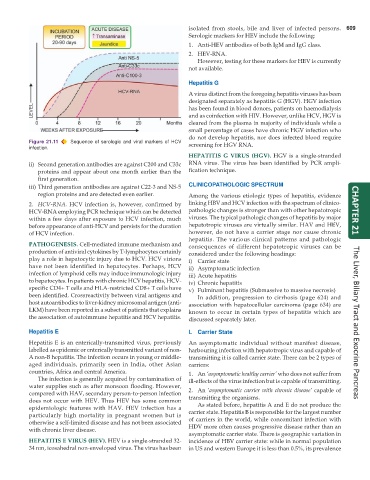
           Figure 21.11  Sequence of serologic and viral markers of HCV  screening for HGV RNA.
           infection.
                                                               HEPATITIS G VIRUS (HGV). HGV is a single-stranded
           ii) Second generation antibodies are against C200 and C33c  RNA virus. The virus has been identified by PCR ampli-
              proteins and appear about one month earlier than the  fication technique.
              first generation.
           iii) Third generation antibodies are against C22-3 and NS-5  CLINICOPATHOLOGIC SPECTRUM
              region proteins and are detected even earlier.   Among the various etiologic types of hepatitis, evidence
           2. HCV-RNA. HCV infection is, however, confirmed by  linking HBV and HCV infection with the spectrum of clinico-
           HCV-RNA employing PCR technique which can be detected  pathologic changes is stronger than with other hepatotropic  CHAPTER 21
           within a few days after exposure to HCV infection, much  viruses. The typical pathologic changes of hepatitis by major
           before appearance of anti-HCV and persists for the duration  hepatotropic viruses are virtually similar. HAV and HEV,
           of HCV infection.                                   however, do not have a carrier stage nor cause chronic
                                                               hepatitis. The various clinical patterns and pathologic
           PATHOGENESIS. Cell-mediated immune mechanism and    consequences of different hepatotropic viruses can be
           production of antiviral cytokines by T-lymphocytes certainly  considered under the following headings:
           play a role in hepatocytic injury due to HCV. HCV virions  i) Carrier state
           have not been identified in hepatocytes. Perhaps, HCV  ii) Asymptomatic infection
           infection of lymphoid cells may induce immunologic injury  iii) Acute hepatitis
           to hepatocytes. In patients with chronic HCV hepatitis, HCV-  iv) Chronic hepatitis
           specific CD4+ T cells and HLA-restricted CD8+ T cells have  v) Fulminant hepatitis (Submassive to massive necrosis)
           been identified. Crossreactivity between viral antigens and  In addition, progression to cirrhosis (page 624) and
           host autoantibodies to liver-kidney microsomal antigen (anti-  association with hepatocellular carcinoma (page 634) are
           LKM) have been reported in a subset of patients that explains  known to occur in certain types of hepatitis which are
           the association of autoimmune hepatitis and HCV hepatitis.  discussed separately later.                    The Liver, Biliary Tract and Exocrine Pancreas

           Hepatitis E                                         I.  Carrier State
           Hepatitis E is an enterically-transmitted virus, previously  An asymptomatic individual without manifest disease,
           labelled as epidemic or enterically transmitted variant of non-  harbouring infection with hepatotropic virus and capable of
           A non-B hepatitis. The infection occurs in young or middle-  transmitting it is called carrier state. There can be 2 types of
           aged individuals, primarily seen in India, other Asian  carriers:
           countries, Africa and central America.              1. An ‘asymptomatic healthy carrier’ who does not suffer from
              The infection is generally acquired by contamination of  ill-effects of the virus infection but is capable of transmitting.
           water supplies such as after monsoon flooding. However,
           compared with HAV, secondary person-to-person infection  2. An ‘asymptomatic carrier with chronic disease’ capable of
           does not occur with HEV. Thus HEV has some common   transmitting the organisms.
           epidemiologic features with HAV. HEV infection has a   As stated before, hepatitis A and E do not produce the
           particularly high mortality in pregnant women but is  carrier state. Hepatitis B is responsible for the largest number
           otherwise a self-limited disease and has not been associated  of carriers in the world, while concomitant infection with
           with chronic liver disease.                         HDV more often causes progressive disease rather than an
                                                               asymptomatic carrier state. There is geographic variation in
           HEPATITIS E VIRUS (HEV). HEV is a single-stranded 32-  incidence of HBV carrier state: while in normal population
           34 nm, icosahedral non-enveloped virus. The virus has been  in US and western Europe it is less than 0.5%, its prevalence

