


Page 626 - Textbook of Pathology, 6th Edition
P. 626
610


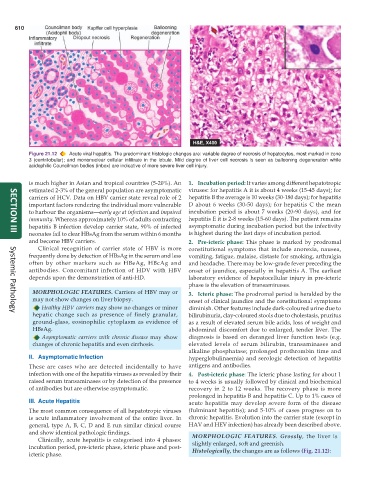
           Figure 21.12  Acute viral hepatitis. The predominant histologic changes are: variable degree of necrosis of hepatocytes, most marked in zone
           3 (centrilobular); and mononuclear cellular infiltrate in the lobule. Mild degree of liver cell necrosis is seen as ballooning  degeneration while
           acidophilic Councilman bodies (inbox) are indicative of more severe liver cell injury.

           is much higher in Asian and tropical countries (5-20%). An  1. Incubation period: It varies among different hepatotropic
           estimated 2-3% of the general population are asymptomatic  viruses: for hepatitis A it is about 4 weeks (15-45 days); for
           carriers of HCV. Data on HBV carrier state reveal role of 2  hepatitis B the average is 10 weeks (30-180 days); for hepatitis
           important factors rendering the individual more vulnerable  D about 6 weeks (30-50 days); for hepatitis C the mean
           to harbour the organisms—early age at infection and impaired  incubation period is about 7 weeks (20-90 days), and for
           immunity. Whereas approximately 10% of adults contracting  hepatitis E it is 2-8 weeks (15-60 days). The patient remains
           hepatitis B infection develop carrier state, 90% of infected  asymptomatic during incubation period but the infectivity
           neonates fail to clear HBsAg from the serum within 6 months  is highest during the last days of incubation period.
     SECTION III
           and become HBV carriers.                            2. Pre-icteric phase: This phase is marked by prodromal
              Clinical recognition of carrier state of HBV is more  constitutional symptoms that include anorexia, nausea,
           frequently done by detection of HBsAg in the serum and less  vomiting, fatigue, malaise, distaste for smoking, arthralgia
           often by other markers such as HBeAg, HBcAg and     and headache. There may be low-grade fever preceding the
           antibodies. Concomitant infection of HDV with HBV   onset of jaundice, especially in hepatitis A. The earliest
           depends upon the demonstration of anti-HD.          laboratory evidence of hepatocellular injury in pre-icteric
                                                               phase is the elevation of transaminases.
            MORPHOLOGIC FEATURES. Carriers of HBV may or       3. Icteric phase: The prodromal period is heralded by the
            may not show changes on liver biopsy.              onset of clinical jaundice and the constitutional symptoms
               Healthy HBV carriers may show no changes or minor  diminish. Other features include dark-coloured urine due to
            hepatic change such as presence of finely granular,  bilirubinuria, clay-coloured stools due to cholestasis, pruritus
     Systemic Pathology
            ground-glass, eosinophilic cytoplasm as evidence of  as a result of elevated serum bile acids, loss of weight and
            HBsAg.                                             abdominal discomfort due to enlarged, tender liver. The
               Asymptomatic carriers with chronic disease may show  diagnosis is based on deranged liver function tests (e.g.
            changes of chronic hepatitis and even cirrhosis.   elevated levels of serum bilirubin, transaminases and
                                                               alkaline phosphatase; prolonged prothrombin time and
           II. Asymptomatic Infection                          hyperglobulinaemia) and serologic detection of hepatitis
           These are cases who are detected incidentally to have  antigens and antibodies.
           infection with one of the hepatitis viruses as revealed by their  4. Post-icteric phase: The icteric phase lasting for about 1
           raised serum transaminases or by detection of the presence  to 4 weeks is usually followed by clinical and biochemical
           of antibodies but are otherwise asymptomatic.       recovery in 2 to 12 weeks. The recovery phase is more
                                                               prolonged in hepatitis B and hepatitis C. Up to 1% cases of
           III. Acute Hepatitis                                acute hepatitis may develop severe form of the disease
           The most common consequence of all hepatotropic viruses  (fulminant hepatitis); and 5-10% of cases progress on to
           is acute inflammatory involvement of the entire liver. In  chronic hepatitis. Evolution into the carrier state (except in
           general, type A, B, C, D and E run similar clinical course  HAV and HEV infection) has already been described above.
           and show identical pathologic findings.               MORPHOLOGIC FEATURES.  Grossly, the liver is
              Clinically, acute hepatitis is categorised into 4 phases:
           incubation period, pre-icteric phase, icteric phase and post-  slightly enlarged, soft and greenish.
                                                                 Histologically, the changes are as follows (Fig. 21.12):
           icteric phase.

