


Page 628 - Textbook of Pathology, 6th Edition
P. 628
612


     SECTION III
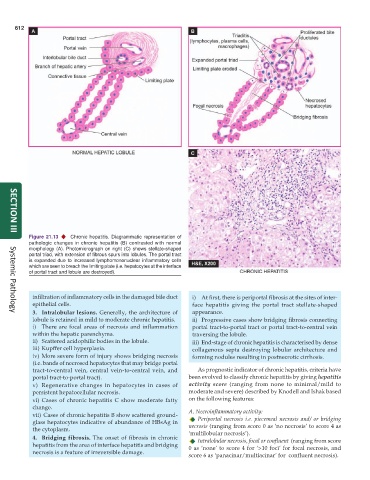
           Figure 21.13  Chronic hepatitis. Diagrammatic representation of
           pathologic changes in chronic hepatitis (B) contrasted with normal
           morphology (A). Photomicrograph on right (C) shows stellate-shaped
           portal triad, with extension of fibrous spurs into lobules. The portal tract
           is expanded due to increased lymphomononuclear inflammatory cells
           which are seen to breach the limiting plate (i.e. hepatocytes at the interface
           of portal tract and lobule are destroyed).


            infiltration of inflammatory cells in the damaged bile duct  i) At first, there is periportal fibrosis at the sites of inter-
            epithelial cells.                                    face hepatitis giving the portal tract stellate-shaped
            3. Intralobular lesions. Generally, the architecture of  appearance.
     Systemic Pathology
            lobule is retained in mild to moderate chronic hepatitis.  ii) Progressive cases show bridging fibrosis connecting
            i) There are focal areas of necrosis and inflammation  portal tract-to-portal tract or portal tract-to-central vein
            within the hepatic parenchyma.                       traversing the lobule.
            ii) Scattered acidophilic bodies in the lobule.      iii) End-stage of chronic hepatitis is characterised by dense
            iii) Kupffer cell hyperplasia.                       collagenous septa destroying lobular architecture and
            iv) More severe form of injury shows bridging necrosis  forming nodules resulting in postnecrotic cirrhosis.
            (i.e. bands of necrosed hepatocytes that may bridge portal
            tract-to-central vein, central vein-to-central vein, and  As prognostic indicator of chronic hepatitis, criteria have
            portal tract-to-portal tract).                     been evolved to classify chronic hepatitis by giving hepatitis
            v) Regenerative changes in hepatocytes in cases of  activity score  (ranging from none to minimal/mild to
            persistent hepatocellular necrosis.                moderate and severe) described by Knodell and Ishak based
            vi) Cases of chronic hepatitis C show moderate fatty  on the following features:
            change.
            vii) Cases of chronic hepatitis B show scattered ground-  A. Necroinflammatory activity:
            glass hepatocytes indicative of abundance of HBsAg in  Periportal necrosis i.e. piecemeal necrosis and/ or bridging
            the cytoplasm.                                     necrosis (ranging from score 0 as ‘no necrosis’ to score 4 as
                                                               ‘multilobular necrosis’).
            4. Bridging fibrosis. The onset of fibrosis in chronic  Intralobular necrosis, focal or confluent  (ranging from score
            hepatitis from the area of interface hepatitis and bridging  0 as ‘none’ to score 4 for ‘>10 foci’ for focal necrosis, and
            necrosis is a feature of irreversible damage.
                                                               score 6 as ‘panacinar/multiacinar’ for  confluent necrosis).

