


Page 629 - Textbook of Pathology, 6th Edition
P. 629
Extent and depth of portal inflammation (ranging from grade  necrosis in which the liver failure is rapid and fulminant  613
           0 as ‘no inflammation’ to grade 4 having ‘marked portal  occurring in 2-3 weeks.
           inflammation’).                                        Fulminant hepatitis of either of the two varieties can occur
                                                               from viral and non-viral etiologies:
           B. Stage of fibrosis:
              Extent and density of fibrosis (ranging from score 0 as ‘no  Acute viral hepatitis accounts for about half the cases, most
           fibrosis’ to score 6 as ‘cirrhosis’).               often from HBV and HCV; less frequently from combined
                                                               HBV-HDV and rarely from HAV. However, HEV infection
           CLINICAL FEATURES.  The clinical features of chronic  is a serious complication in pregnant women. In addition,
           hepatitis are quite variable ranging from mild disease to full-  herpesvirus can also cause serious viral hepatitis.
           blown picture of cirrhosis.                            Non-viral causes include acute hepatitis due to drug
           i) Mild chronic hepatitis shows only slight but persistent  toxicity (e.g. acetaminophen, non-steroidal anti-
           elevation of transaminases (‘transaminitis’) with fatigue,  inflammatory drugs, isoniazid, halothane and anti-
           malaise and loss of appetite.                       depressants), poisonings, hypoxic injury and massive
           ii) Other cases may show mild hepatomegaly, hepatic  infiltration of malignant tumours into the liver.
           tenderness and mild splenomegaly.                      The patients present with features of hepatic failure with
                                                               hepatic encephalopathy (page 602). The mortality rate is high
           iii) Laboratory findings may reveal prolonged prothrombin  if hepatic transplantation is not undertaken.
           time, hyperbilirubinaemia, hyperglobulinaemia and
           markedly elevated alkaline phosphatase.
                                                                 MORPHOLOGIC FEATURES. Grossly, the liver is small
           iv) Systemic features of circulating immune complexes due  and shrunken, often weighing 500-700 gm. The capsule
           to HBV and HCV infection may produce features of immune  is loose and wrinkled. The sectioned surface shows diffuse
           complex vasculitis, glomerulonephritis and cryoglobuli-  or random involvement of hepatic lobes. There are
           naemia in a proportion of cases.                      extensive areas of muddy-red and yellow necrosis
              However, clinical features do not correlate with morpho-  (previously called  acute yellow atrophy) and patches of
           logic appearance of the liver biopsy. Some patients may have  green bile staining.
           mild form of disease without progressing for several years  Histologically, two forms of fulminant necrosis are  CHAPTER 21
           while others may show rapid evolution into cirrhosis with  distinguished—submassive and massive necrosis
           its complications over a period of few years. Patients of long-  (Fig. 21.14).
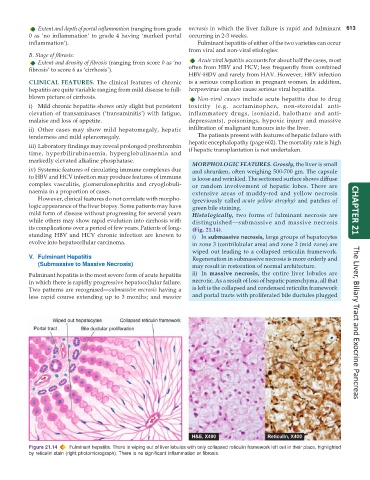
           standing HBV and HCV chronic infection are known to   i) In submassive necrosis, large groups of hepatocytes
           evolve into hepatocellular carcinoma.                 in zone 3 (centrilobular area) and zone 2 (mid zone) are
                                                                 wiped out leading to a collapsed reticulin framework.
           V. Fulminant Hepatitis                                Regeneration in submassive necrosis is more orderly and
              (Submassive to Massive Necrosis)                   may result in restoration of normal architecture.
           Fulminant hepatitis is the most severe form of acute hepatitis  ii) In  massive necrosis, the entire liver lobules are
           in which there is rapidly progressive hepatocellular failure.  necrotic. As a result of loss of hepatic parenchyma, all that
           Two patterns are recognised—submassive necrosis having a  is left is the collapsed and condensed reticulin framework
           less rapid course extending up to 3 months; and massive  and portal tracts with proliferated bile ductules plugged  The Liver, Biliary Tract and Exocrine Pancreas


           Figure 21.14  Fulminant hepatitis. There is wiping out of liver lobules with only collapsed reticulin framework left out in their place, highlighted
           by reticulin stain (right photomicrograph). There is no significant inflammation or fibrosis.

