


Page 633 - Textbook of Pathology, 6th Edition
P. 633
617


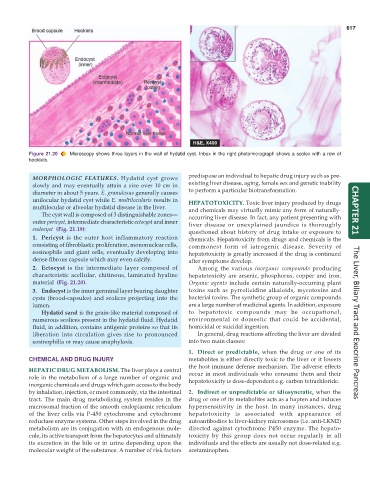
           Figure 21.20  Microscopy shows three layers in the wall of hydatid cyst. Inbox in the right photomicrograph shows a scolex with a row of
           hooklets.


            MORPHOLOGIC FEATURES. Hydatid cyst grows           predispose an individual to hepatic drug injury such as pre-
            slowly and may eventually attain a size over 10 cm in  existing liver disease, aging, female sex and genetic inability
            diameter in about 5 years. E. granulosus generally causes  to perform a particular biotransformation.
            unilocular hydatid cyst while E. multilocularis results in  HEPATOTOXICITY. Toxic liver injury produced by drugs
            multilocular or alveolar hydatid disease in the liver.  and chemicals may virtually mimic any form of naturally-
               The cyst wall is composed of 3 distinguishable zones—  occurring liver disease. In fact, any patient presenting with  CHAPTER 21
            outer pericyst, intermediate characteristic ectocyst and inner  liver disease or unexplained jaundice is thoroughly
            endocyst  (Fig. 21.19):                            questioned about history of drug intake or exposure to
            1. Pericyst is the outer host inflammatory reaction  chemicals. Hepatotoxicity from drugs and chemicals is the
            consisting of fibroblastic proliferation, mononuclear cells,  commonest form of iatrogenic disease. Severity of
            eosinophils and giant cells, eventually developing into  hepatotoxicity is greatly increased if the drug is continued
            dense fibrous capsule which may even calcify.      after symptoms develop.
            2. Ectocyst is the intermediate layer composed of     Among the various  inorganic compounds  producing
            characteristic acellular, chitinous, laminated hyaline  hepatotoxicity are arsenic, phosphorus, copper and iron.
            material  (Fig. 21.20).                            Organic agents  include certain naturally-occurring plant
            3. Endocyst is the inner germinal layer bearing daughter  toxins such as pyrrolizidine alkaloids, mycotoxins and
            cysts (brood-capsules) and scolices projecting into the  bacterial toxins. The synthetic group of organic compounds
            lumen.                                             are a large number of medicinal agents. In addition, exposure
               Hydatid sand is the grain-like material composed of  to hepatotoxic compounds may be occupational,
            numerous scolices present in the hydatid fluid. Hydatid  environmental or domestic that could be accidental,
            fluid, in addition, contains antigenic proteins so that its  homicidal or suicidal ingestion.             The Liver, Biliary Tract and Exocrine Pancreas
            liberation into circulation gives rise to pronounced  In general, drug reactions affecting the liver are divided
            eosinophilia or may cause anaphylaxis.             into two main classes:
                                                               1. Direct or predictable,  when the drug or one of its
           CHEMICAL AND DRUG INJURY                            metabolites is either directly toxic to the liver or it lowers
                                                               the host immune defense mechanism. The adverse effects
           HEPATIC DRUG METABOLISM. The liver plays a central  occur in most individuals who consume them and their
           role in the metabolism of a large number of organic and  hepatotoxicity is dose-dependent e.g. carbon tetrachloride.
           inorganic chemicals and drugs which gain access to the body
           by inhalation, injection, or most commonly, via the intestinal  2. Indirect or unpredictable or idiosyncratic,  when the
           tract. The main drug metabolising system resides in the  drug or one of its metabolites acts as a hapten and induces
           microsomal fraction of the smooth endoplasmic reticulum  hypersensitivity in the host. In many instances, drug
           of the liver cells via P-450 cytochrome and cytochrome  hepatotoxicity is associated with appearance of
           reductase enzyme systems. Other steps involved in the drug  autoantibodies to liver-kidney microsomes (i.e. anti-LKM2)
           metabolism are its conjugation with an endogenous mole-  directed against cytochrome P450 enzyme. The hepato-
           cule, its active transport from the hepatocytes and ultimately  toxicity by this group does not occur regularly in all
           its excretion in the bile or in urine depending upon the  individuals and the effects are usually not dose-related e.g.
           molecular weight of the substance. A number of risk factors  acetaminophen.

