


Page 17 - BULETIN
P. 17
Learning Mathematics In School Through Problem Based
                                                 Learning


                                                Soh Hon Mun
          Traditional educational approaches have resulted in an incongruity between what is taught to
          the students in schools and what the industry nowadays needs. Traditional educational
          approaches make students lose the ability to think and to have difficulties with self-directed
          learning. Consequently, many schools are moving towards problem-based learning as a
          solution to producing students who are more creative, can think critically and analytically.
          Problem-based learning is seen as an innovative measure to encourage students to “learn how
          to learn” via “real-life” problems (Boud and Feletti, 1999).

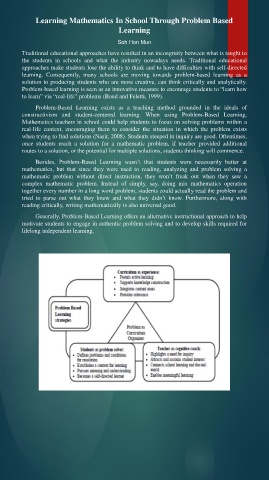
               Problem-Based Learning exists as a teaching method grounded in the ideals of
          constructivism and student-centered learning. When using Problem-Based Learning,
          Mathematics teachers in school could help students to focus on solving problems within a
          real-life context, encouraging them to consider the situation in which the problem exists
          when trying to find solutions (Nasir, 2008). Students steeped in inquiry are good. Oftentimes,
          once students reach a solution for a mathematic problem, if teacher provided additional
          routes to a solution, or the potential for multiple solutions, students thinking will commence.

               Besides, Problem-Based Learning wasn’t that students were necessarily better at
          mathematics, but that since they were used to reading, analyzing and problem solving a
          mathematic problem without direct instruction, they won’t freak out when they saw a
          complex mathematic problem. Instead of simply, say, doing mix mathematics operation
          together every number in a long word problem, students could actually read the problem and
          tried to parse out what they knew and what they didn’t know. Furthermore, along with
          reading critically, writing mathematically is also universal good.

               Generally, Problem-Based Learning offers an alternative instructional approach to help
          motivate students to engage in authentic problem solving and to develop skills required for
          lifelong independent learning.

