


Page 123 - Career Readiness Catalog
P. 123
AGRICULTURAL SCIENCE


         POWER SYSTEMS BUNDLE 1
         Kit #AG-S05         $312.35 (Savings of $68 .55)

         THIS BUNDLE CONTAINS THE FOLLOWING KITS:
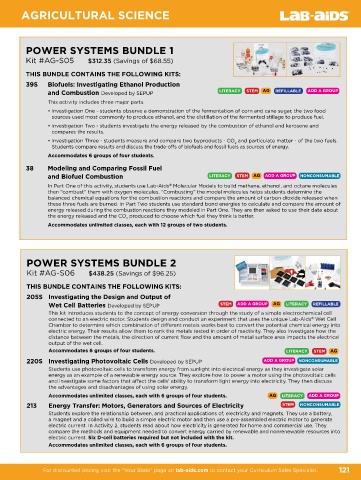
         39S      Biofuels: Investigating Ethanol Production
                and Combustion Developed by SEPUP                      LITERACY  STEM   AG  REFILLABLE  ADD A GROUP
                This activity includes three major parts .
                •  Investigation One - students observe a demonstration of the fermentation of corn and cane sugar, the two food
                  sources used most commonly to produce ethanol, and the distillation of the fermented stillage to produce fuel .
                •  Investigation Two - students investigate the energy released by the combustion of ethanol and kerosene and
                  compares the results .
                •  Investigation Three - students measure and compare two byproducts - CO  and particulate matter - of the two fuels .
                                                                            2
                  Students compare results and discuss the trade-offs of biofuels and fossil fuels as sources of energy .
                Accommodates 6 groups of four students.
         38       Modeling and Comparing Fossil Fuel
                and Biofuel Combustion                              LITERACY  STEM   AG  ADD A GROUP  NONCONSUMABLE
                  In Part One of this activity, students use Lab-Aids  Molecular Models to build methane, ethanol, and octane molecules
                                                       ®
                then “combust” them with oxygen molecules . “Combusting” the model molecules helps students determine the
                balanced chemical equations for the combustion reactions and compare the amount of carbon dioxide released when
                these three fuels are burned . In Part Two students use standard bond energies to calculate and compare the amount of
                energy released during the combustion reactions they modeled in Part One . They are then asked to use their data about
                the energy released and the CO  produced to choose which fuel they think is better .
                                         2
                Accommodates unlimited classes, each with 12 groups of two students.


         POWER SYSTEMS BUNDLE 2

         Kit #AG-S06         $438.25 (Savings of $96 .25)
         THIS BUNDLE CONTAINS THE FOLLOWING KITS:
         205S   Investigating the Design and Output of
                Wet Cell Batteries Developed by SEPUP                  STEM    ADD A GROUP  AG  LITERACY  REFILLABLE
                 This kit introduces students to the concept of energy conversion through the study of a simple electrochemical cell
                 connected to an electric motor . Students design and conduct an experiment that uses the unique Lab-Aids  Wet Cell
                                                                                                    ®
                 Chamber to determine which combination of different metals works best to convert the potential chemical energy into
                 electric energy . Their results allow them to rank the metals tested in order of reactivity . They also investigate how the
                 distance between the metals, the direction of current flow and the amount of metal surface area impacts the electrical
                 output of the wet cell .
                Accommodates 6 groups of four students.                                     LITERACY  STEM   AG

         220S   Investigating Photovoltaic Cells Developed by SEPUP                  ADD A GROUP  NONCONSUMABLE
                 Students use photovoltaic cells to transform energy from sunlight into electrical energy as they investigate solar
                 energy as an example of a renewable energy source . They explore how to power a motor using the photovoltaic cells
                 and investigate some factors that affect the cells’ ability to transform light energy into electricity . They then discuss
                 the advantages and disadvantages of using solar energy .
                Accommodates unlimited classes, each with 6 groups of four students.   AG  LITERACY  ADD A GROUP
         213    Energy Transfer: Motors, Generators and Sources of Electricity             STEM    NONCONSUMABLE
                Students explore the relationship between, and practical applications of, electricity and magnets . They use a battery,
                a magnet and a coiled wire to build a simple electric motor and then use a pre-assembled electric motor to generate
                electric current . In Activity 2, students read about how electricity is generated for home and commercial use . They
                compare the methods and equipment needed to convert energy carried by renewable and nonrenewable resources into
                electric current . Six D-cell batteries required but not included with the kit.
                Accommodates unlimited classes, each with 6 groups of four students.


               For discounted pricing visit the “Your State” page on lab-aids.com to contact your Curriculum Sales Specialist.  121

