


Page 173 - Career Readiness Catalog
P. 173
SECOND EDITION


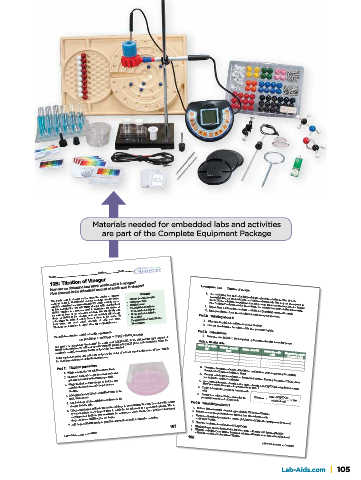
                              Materials needed for embedded labs and activities
                                 are part of the Complete Equipment Package


                 Name:________________________________Section:_________Date:_______
                 13B: Titration of Vinegar
                 How can we determine how much acetic acid is in vinegar?  Investigation 13B:       Titration of Vinegar
                 How accurate is the advertised amount of acetic acid in vinegar?
                                             Materials
                 The acetic acid in vinegar comes from the apples  or grapes   •   Vinegar (normal strength)           9.    Repeat Steps 1–8 three times to obtain a reliable and (hopefully) reproducible result.
                 used to make it. Commercial  vinegar  contains  mostly water,
                                          •   Erlenmeyer flask
                                                                          8.       You are looking for a pink color that persists throughout the solution for 30 to 60 s. To
                 and it is advertised as approximately 5% acetic acid by mass.
                                          •   Distilled water
                  In  this investigation we will titrate  vinegar with standardized
                                                                    accomplish this, you must swirl often and add your drops slowly. One drop can cause you to go
                                          •   Phenolphthalein indicator
                  NaOH.  Titration is a process used to determine  the moles of
                                                                    too far. If your solution is too pink and does not go away, this means you have gone too far past
                                          •   50 mL graduated cylinder
                  an acid or base in an aqueous  solution. We will  slowly  add
                                                                    your “endpoint” and your solution is now basic. You actually want your solution to be neutral.
                                          •   10 mL graduated cylinder
                  drops  of NaOH  to the vinegar, and  our solution  will  change
                  color when the ratio of acid to base is close to the same. To
                                                                          10.  Rinse your titration down the sink with water and clean your glassware.
                                          •   Dropper bottle of 1.0 M NaOH
                                                                Part 2:   Thinking about it
                  form water, we need equal  amounts of acid and base.
                  Titrations use indicators to signal when the endpoint is near.
                                          •   Mass balance
                                                                         1.      What does the pink color tell you about your titration?
                                                                         2.      How can you determine the volume of the base you used? Explain.
                  The acid–base reaction carried out in this experiment is  •   Beral pipet  Part 3:   Calculations
                          CH 3 COOH(aq)  +  NaOH(aq)  →  H 2 O(l) + NaCH 3 COO(aq)
                   Our  goal is to completely  “neutralize”  the acetic acid (CH 3 COOH).  If  we  add  just  the  right  amount  of       Table 1. Titration data  (mL)  Moles of NaOH  Moles of acetic   Percent by mass
                   NaOH to the solution, we will end up with water (H 2 O) and salt (NaCH 3 COO, sodium acetate). When the
                                                                         1.      Enter your data in Table 1. For comparison, gather some other data from other groups.
                   solution is neutral, we can say that the endpoint has been reached.
                                                                Mass of vinegar
                   At the equivalent point, also called the endpoint, the moles of acid are equal to the moles of base. This is
                                                                  (g)
                                                                       Volume of NaOH
                                                                                       acid
                   the most important aspect of the titration process.
                                                                                            of acetic acid
                   Part 1:   Titration procedure                        2.      Determine the number of moles of NaOH you used to titrate your vinegar using the molarity
                     1.    Weigh a clean, dry 125 mL Erlenmeyer flask.
                     2.    Measure 1.6 mL of vinegar in a small graduated
                                                                  formula. M = X moles / (volume in liters).
                      cylinder, and add it to the Erlenmeyer flask
                                                                  you to find the moles of acetic acid.
                      3.    Weigh the flask and the vinegar so that you can            4.      Next, convert the moles of acetic acid to grams of acetic acid (CH 3 COOH) using the molar mass.
                                                                        3.        The mole ratio is one to one based on the chemical reaction. Knowing the moles of NaOH allows
                       calculate the exact mass of vinegar you are
                                                                  Show your calculations and enter your results on Table 1.
                       titrating.
                      4.    Add approximately 25 mL of distilled water to the            6.      Record your value in Table 1. Determine the
                                                                 acid:
                                                                       5.      Lastly, determine the percent by mass of acetic
                       flask. Swirl to mix.
                      5.    Add 3–4 drops of phenolphthalein indicator to the   percent by mass of each of your trials.  % by mass   =           mass of vinegar  3 100
                                                                                         mass of CH 3 COOH
                      6.    Using a beral pipet, calibrate the number of drops in one milliliter. You may have done this before      a.    Is it true that commercial vinegar is approximately 5% by mass? Explain.
                       vinegar. Swirl to mix.
                       by counting how many drops it takes to reach the 1.0 mL mark on a graduated cylinder. This is
                                                              Part 4:   What did you learn?
                       very important. It allows you to estimate the volume you use to titrate. Once you know how many
                       7.  Add drops of NaOH slowly to your Erlenmeyer flask. Swirl to mix after each drop.     c.         If you overtitrated and your solution was too pink, how would this affect your percent by mass of
                        drops are in one milliliter, you can begin.
                                                                 b.       List two sources of experimental error that may have affected your results.
                                                               acetic acid? Explain.
                                                       107      d.       Show the Lewis structure of acetic acid (CH 3 COOH).
                                                                e.        Which hydrogen atom is the one that is lost when acetic acid reacts with the base (NaOH)?
                     A NAturAl ApproAch to chemistry         108  acidand the number of moles of base? Explain.  A NAturAl ApproAch to chemistry
                                                                f.         When the endpoint of your titration is reached, what should be true about the number of moles of
                                                                                           Lab-Aids.com  |  105

