


Page 146 - 8th-language-english-2
P. 146
PoETRY

                                                      MachinE

                                                                                - Rudyard Kipling
                          Not to be republished
                     iRa    Read what Encyclopedia Britannica has to say about a
                     Machine and answer the questions that follow.

                         A device that amplifies or replaces human or animal effort to
                          ©KTBS
                     accomplish a physical task.  The first five simple machines are : The lever,
                     the wedge, the wheel and axle, the pulley, and the screw; all complex
                     machines are combinations of these devices.  The operation of a machine
                     may involve the transformation of chemical, thermal, electrical or nuclear
                     energy into mechanical energy, or vice versa.

                         * Name a few machines that we use.  How do they run or work?
                         * “Man has learnt how to sail on the seas, how to fly in the sky, and
                     how to reach the moon; but, he has not yet learnt how to live on this
                     earth”  is a famous statement.  Do you agree?  Have a discussion with
                     your partner in the class.
                         * Some words are given in the box.  Classify them into words used
                     in Mechanics and words used in Biology.  Note that some may be used
                     in both.
                         You may consult a good dictionary to do this.

                          emu, cog, nut, wedge, bear, mouse, furnace, tool, boar, rhino, file,
                     ray, turtle, mink

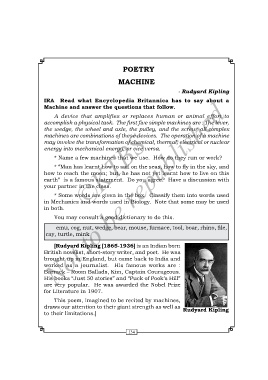
                         [Rudyard Kipling [1865-1936] is an Indian born
                     British novelist, short-story writer, and poet.  He was
                     brought up in England, but came back to India and
                     worked  as  a  journalist.    His  famous  works  are  :
                     Barrack – Room Ballads, Kim, Captain Courageous.
                     His books “Just 50 stories” and “Puck of Pook’s Hill”
                     are very popular.  He was awarded the Nobel Prize
                     for Literature in 1907.
                         This poem, imagined to be recited by machines,
                     draws our attention to their giant strength as well as       Rudyard Kipling
                     to their limitations.]


                                                          134

