


Page 70 - Jurnal Kurikulum BPK 2018
P. 70
Besides, educators do not discuss among themselves or critically review about the types
               of questions they post to students either in oral or written form and also other types of methods or
               learning strategies in order for accountability of assessment takes place (Black, 1998; DeLuca &
               Johnson, 2017). Furthermore, low-levels question items seemed to be teachers’ everyday’s work
               as it is easier to do (Sardareh & Mohd Rashid, 2013). Many educators also resort to grading
               functions as it seems the only easiest thing to do, thus leading to the failure of self-assessment by
               students as they do not a comprehensive idea on how to assess themselves.
                      The challenges stated above is also seen in the local context. Although not many researches
               on assessment have been done in Malaysian schools as assessment is only seen important in recent
               years, Malaysian teachers are generally unaware of the importance of feedback and effective
               questioning  techniques  to  enhance  learner’s  autonomy.  Studies  done  by  Sardareh  (2016)  and
               Sardareh, Abdul Rashid, Abdul Jalil & Rosalam (2014) showed that Malaysian teachers lacked
               pedagogical skills such as giving appropriate feedback and questioning techniques to enhance
               students’ learning.

                                 Enhancing Classroom Assessment in Malaysian Context

                      In  Malaysian  schools,  the  emphasis  is  on  formative  assessment,  although  summative
               assessment  is  inevitable  as  less  emphasized  is  given  to  avoid  high-stakes  testing.  The  main
               purpose is to improve students’ learning and teachers’ instructional approach and strategies (Black
               1998, William & Leahy, 2015). Classroom assessment is the key towards developing a child
               holistically  in  terms  of  cognitive,  affective  and  psychomotor  as  mentioned  in  the  Malaysian
               Education  Blueprint  2013  –  2025  (MOE  2013)  in  tandem  with  the  Malaysian  Philosophy  of
               Education. Therefore, exam-oriented education is less emphasized. The focus is more fun, deep
               and meaningful learning, together with rigorous classroom assessment where the focal point is on
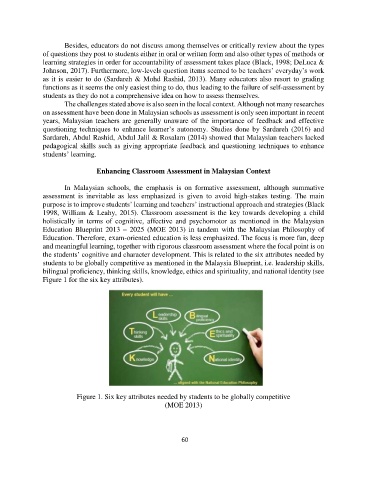
               the students’ cognitive and character development. This is related to the six attributes needed by
               students to be globally competitive as mentioned in the Malaysia Blueprint, i.e. leadership skills,
               bilingual proficiency, thinking skills, knowledge, ethics and spirituality, and national identity (see
               Figure 1 for the six key attributes).


                          Figure 1. Six key attributes needed by students to be globally competitive
                                                        (MOE 2013)


                                                             60

