


Page 350 - fbkCardioDiabetes_2017
P. 350
326       Risk Stratification  in  Asymptomatic  Diabetics :Role Of Selective
                           Imaging  With  Cardiac  CT And  Myocardial  Perfusion  Imaging


              the necessity to define the cardiovascular risk in the   and to determine its association with myocardial per-
              asymptomatic diabetic population who could benefit   fusion abnormalities (Anand et al.)(Ref 4)
              from this screening.  Due  to the  high rate of cardio-  (figure-1).
              vascular mortality and morbidity in the type-2 diabet-
              ic population,  there has been considerable  interest
              in establishing the incidence of subclinical or occult
              CAD and the factors influencing it. The exercise-ECG
              has poor accuracy for detecting CAD in asymptomat-
              ic diabetic patients. Though the DIAD study investiga-
              tors  reported  a  20% prevalence  of  silent  myocardial
              ischemia in a large  asymptomatic  diabetic cohort
              (n=1123) using SPECT imaging, this was not a cost-ef-
              fective method for screening large populations.

              Improvements in risk stratification by
              imaging subclinical atherosclerosis
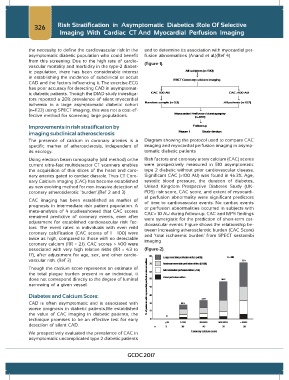
              The  presence  of calcium  in coronary  arteries  is  a   Diagram showing the protocol used to compare CAC
              specific  marker  of atherosclerosis,  independent of   imaging and myocardial perfusion imaging in asymp-
              its etiology.                                      tomatic diabetic patients
              Using electron beam tomography (old method) orthe   Risk factors and coronary artery calcium (CAC) scores
              current ultra-fast multidetector CT scanners enables   were  prospectively  measured in 510 asymptomatic
              the acquisition of thin  slices of the heart and coro-  type 2 diabetic without  prior cardiovascular disease.
              nary arteries gated to cardiac diastole. Thus CT Coro-  Significant CAC (>100 AU) was found in 46.3%. Age,
              nary Calcium Imaging (CAC) has become established   systolic  blood pressure,  the duration of diabetes,
              as new evolving method for non-invasive detection of   United  Kingdom Prospective  Diabetes  Study  (UK-
              coronary atherosclerotic ‘burden’.(Ref 2 and 3)    PDS) risk score, CAC score, and extent of myocardi-
                                                                 al perfusion  abnormality were  significant predictors
              CAC imaging  has been established as marker  of    of  time to cardiovascular events. No  cardiac events
              prognosis  in intermediate risk  patient population. A   or perfusion abnormalities occurred in subjects with
              meta-analysis of 4 studiesshowed that  CAC scores   CAC< 10 AU during follow-up. CAC and MPS findings
              remained  predictive  of coronary  events, even after   were synergistic for the prediction of short-term car-
              adjustment  for  established  cardiovascular risk  fac-  diovascular events. Figure shows the relationship be-
              tors.  The event rates  in individuals with  even mild   tween increasing atherosclerotic burden (CAC Score)
              coronary  calcification  (CAC scores  of  1  –  100)  were   and ‘total ischaemic burden’ from  SPECT  sestamibi
              twice as high, compared to those with no detectable   imaging
              coronary calcium (RR = 2.1). CAC scores > 400 were
              associated with very  high  relative  risks  (RR  =  4.3 to   (figure-2).
              17), after  adjustment  for  age,  sex,  and other  cardio-
              vascular risk. (Ref 3)
              Though the calcium score represents an estimate of
              the total  plaque  burden present  in an  individual,  it
              does not correspond directly to the degree of luminal
              narrowing of a given vessel.
              Diabetes and Calcium Score:

              CAD is often asymptomatic  and is  associated with
              worse  prognosis  in  diabetic patients.We  established
              the  value  of CAC  imaging in diabetic  patients,  the
              technique  promises  to be an  effective test for early
              detection of silent CAD.
              We prospectively evaluated the prevalence of CAC in
              asymptomatic uncomplicated type 2 diabetic patients


                                                         GCDC 2017

