


Page 42 - fbkCardioDiabetes_2017
P. 42
18          Genesis Growth And Future of Cardiodiabetic Medicine


          have shown that  hypoglycemias  are  causing some   Track ‘A’ (1979-to-date)
          modifications in the PQRST characteristics of ECGs,   Protein  energy  malnutrition  in early  infancy,  with or
          especially a prolongation in the QT intervals . One of   without a deficiency of other essential micronutrients.
          these studies also suggests that this may allow the
          development of an  hypoglycemia  detection  device .   Track ‘B’ (1988 – to- date)

          The D1NAMO project aims at using such technology   Low birth weight (less  than  2.5Kg) and lower  body
          to monitor type  1 diabetes  in a non-invasive way.   weight at one year
          The  PQRST characteristics with the QT interval The
          D1NAMO  concept is  the following:  Diabetic patients   Track ‘C’ (1992-to-date)
          are wearing an  ECG  sensor  which  is connected   The  growth  of  the fetus  (and possibly  infant)  is
          by Bluetooth to their smartphones. An Android      quantitatively and qualitatively altered.
                                                             Poor  insulin secretion  and insulin resistance  can
                                                             result  from these adaptive processes,  include loss
                                                             of glucose tolerance and hypertension.

                                                             Early  Nutritional deprivation :  Impact on Cell
                                                             Programming
                                                             Thus, the concept  of malnutrition-related cellular
                                                             programming  (MRCP)  provides  a  rational basis
                                                             of  such  diverse  metabolic syndromes  as  MRDM,
                                                             NIDDM, hypertension, obesity  and CAD and offers
                                                             a unifying hypothesis.  A  conceptual  model  of such
                                                             a hypothesis.
                                                             Unifying Hypothesis: MRDM, NIDDM, Syndrome ‘X’


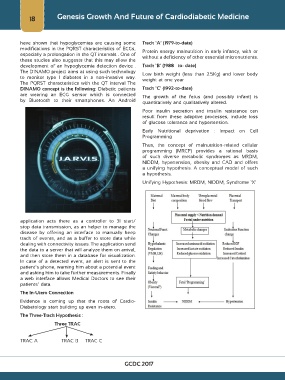
          application  acts there  as  a  controller  to 31 start/
          stop data transmission, as an helper to manage the
          disease  by  offering  an interface to manually keep
          track of events, and  as a buffer  to store  data  while
          dealing with connectivity issues. The application send
          the data to a server that will analyze them on arrival,
          and then store them in a database for visualization.
          In case of  a detected event, an alert  is  sent to the
          patient’s phone, warning him about a potential event
          and asking him to take further measurements. Finally
          a web interface allows Medical Doctors to see  their
          patients’ data.
          The In-Utero Connection
          Evidence is  coming up that  the roots  of Cardio-
          Diabetology start building up even in-utero.

          The Three-Track Hypothesis :
                                      Three TRAC


          TRAC A              TRAC B    TRAC C


                                                     GCDC 2017

