


Page 468 - fbkCardioDiabetes_2017
P. 468
444                              Obesity- Pharmacotherapy


              ≥30  kg/m  ),  after taking into  account  age, gender,   complications that can be ameliorated by weight loss.
                      2
              ethnicity,  fluid  status, and  muscularity; therefore,   Pharmacotherapy should be offered to patients with
              clinical evaluation and judgment must be used when   obesity, when potentialbenefits outweigh the risks.
              BMI  is  employed as the anthropometric indicator  of    Short-term treatment (3-6 months) using weight-loss
              excess  adiposity, particularly  in athletes and those   medications has not been demonstrated to produce
              with sarcopenia.
                                                                 long  term health benefits  and cannot  be  generally
              At a defined BMI, the pattern of fat distribution can   recommended based on scientific evidence.
              vary  substantially.  This  has been  most impressively   Clinicians should consider differences in efficacy, side
              shown using computed tomography (CT) or magnetic   effects, cautions, and that  characterize  medications
              resonance imaging  (MRI)  scans which  are  the only   approved for chronic management of obesity, as well
              imaging techniques  to provide  a direct assessment   as the presence of weight-related complications and
              of  the  size  of  the intra-abdominal visceral  adipose   medical history.
              tissue.
                                                                 Treatment  is  individualized  based weight-loss
              For  practical means, waist circumference provides   pharmacotherapy; a generalizable  algorithm for
              a simple anthropometric measure to assess  the  fat   medication  preferences that would  be applicable  to
              distribution pattern. This  variable  has been  used  in   all patients cannot currently be scientifically justified.
              many cross-sectional  and longitudinal studies; the
              waist circumference is  closely  correlated  with  BMI   Combinations  of  FDA-approved  weight-loss
              but cannot discriminate between subcutaneous and   medications should only  be  used  in a manner
              intra-abdominal fat depots.  Due to this limitation,   approved by the FDA.
              there is growing clinical  interest  for  more  precise   There is lack of clinical trials with head to head direct
              imaging  methods to obtain a better  insight into   comparing the drugs approved for weight loss.
              intra-abdominal  and ectopic fat deposition  (visceral
              fat, hepatic fat)  in order  to improve  individual risk   Current /Fda Approved Anti-Obesity Drugs
              assessment.
                                                                 The approval criteria for antiobesity drugs as set out
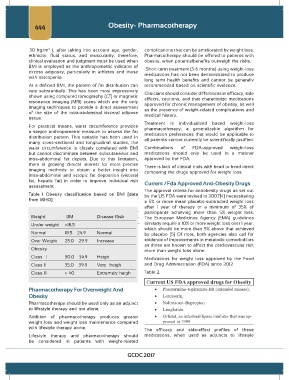
              Table  1  Obesity classification based  on BMI  [data   by the US FDA were revised in 2007[4] necessitating
              from WHO]                                          a 5% or  more mean  placebo-subtracted  weight loss
                                                                 after  1  year  of  therapy  or  a minimum  of  35% of
                                                                 participants achieving more  than  5% weight loss.
               Weight          BM           Disease Risk         The European Medicines Agency (EMA)  guidelines
               Under weight   <18.5                              similarly require a 10% or more weight loss over 1 year,
                                                                 which should be more than 5% above that achieved
               Normal         18.5 – 24.9   Normal               by placebo [5]  Of  note,  both  agencies also call for

               Over Weight    25.0 – 29.9   Increase             evidence of improvements in metabolic comorbidities
                                                                 as these are known to affect the cardiovascular risk
               Obesity                                           more than weight loss alone.
               Class  I       30.0 – 34.9   Heigh                Medications  for weight loss  approved  by the  Food
               Class II       35.0 – 39.9   Very  heigh          and Drug Administration (FDA) since 2012
               Class III      > 40          Extremely heigh      Table 2.
                                                                  Current US FDA approved drugs for Obesity

              Pharmacotherapy For Overweight And                     •   Phentermine–topiramate ER (extended release),
              Obesity                                                •   Lorcaserin,

              Pharmacotherapy should be used only as an adjunct      •   Naltrexone–Bupropion
              to lifestyle therapy and not alone.                    •   Liraglutide.
              Addition of pharmacotherapy produces  greater          •   Orlistat, an intestinal lipase inhibitor that was ap-
              weight loss and weight loss maintenance compared           proved in 1999
              with lifestyle therapy alone.                      The  efficacy and side-effect  profiles  of  these

              Lifestyle  therapy  and pharmacotherapy should     medications,  when  used as adjuncts  to lifestyle
              be  considered in patients with weight-related


                                                         GCDC 2017

