


Page 484 - fbkCardioDiabetes_2017
P. 484
Heart Failure: Drug Thaerapies &
                460                           Revascularization Strategies


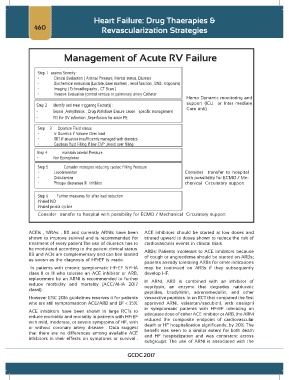
                             Management of Acute RV Failure


                  Step  1  assess Severity :
                  •      Clinical Evaluation ( Arterial Pressure, Mental status, Diuresis
                  •      Biochemical evaluation (Lactate, Liver markers , renal function , BNB , troponins)
                  •      Imaging ( Echocadiography , CT Scan )
                  •      Invasive Evaluation (central venous or pulmonary artery Catheter
                                                                                   Hemo Dynamic monitoring and
                                                                                   support  (ICU  or  Inter  mediate
                 Step 2     Identify and treat triggering Factor(s) :
                 •      Sepsis ,Arrhythmias , Drug Withdrawl Ensure cause – specific management   Care unit)
                 •      PCI for RV infarction ,Reperfusion for acute PE
                  Step    3     Optimize Fluid status
                  •      Iv Diuretics if Volume Over load
                  •      RRT if situation insufficiently managed with diuretics
                  •      Cautious fluid Filling If low CVP ,Avoid over filling
                 Step 4            maintain arterial Pressure
                 •       Nor Epinephrine
                  Step 5             Consider inotropes reducing cardiac Filling Pressure
                  •      Levosimendan                                              Consider   transfer  to hospital
                  •      Dobutamine                                                with possibility for ECMO / Me-
                  •      Phospo diestarase III  Inhibitor                          chanical  Circulatory support

                  Step 6       Further measures for after load reduction
                  Inhaled NO
                  Inhaled prosta cycline
                  Consider  transfer to hospital with possibility for ECMO / Mechanical  Circulatory support


              ACEIs  , MRAs  , BB  and currently  ARNIs  have been   ACE inhibitors should be started at  low doses  and
              shown to improve  survival and is  recommended for   titrated upward to doses shown to reduce the risk of
              treatment of every patient.The use of diuretics has to   cardiovascular events in clinical trials.
              be modulated according to the patient clinical status.   ARBs:  Patients  intolerant to ACE inhibitors  because
              BB and ACIs are complementary and can bee started   of cough or angioedema should be started on ARBs;
              as soosn as the diagnosis of HFrEF is made.
                                                                 patients already tolerating ARBs for other indications
               In patients with chronic  symptomatic HFrEF  NYHA   may be  continued on ARBs  if  they  subsequently
              class  II or  III  who tolerate  an ACE inhibitor or  ARB,   develop HF.
              replacement by an ARNI is recommended to further   In ARNI, ARB is  combined  with  an  inhibitor of
              reduce morbidity and  mortality (ACC/AHA  2017     neprilysin,  an  enzyme that degrades  natriuretic
              classI).
                                                                 peptides,  bradykinin,  adrenomedullin, and other
              However ESC 2016 guidelines reserves it for patients   vasoactive peptides. In an RCT that compared the first
              who are still symptomaticon ACE/ARB and EF < 35%.  approved  ARNI,  valsartan/sacubitril, with enalapril
                                                                 in symptomatic patients with  HFrEF  tolerating an
              ACE inhibitors have been shown in large  RCTs  to
              reduce morbidity and mortality in patients with HFrEF   adequate dose of either ACE inhibitor or ARB, the ARNI
              with mild, moderate, or severe symptoms of HF, with   reduced the  composite endpoint of cardiovascular
              or  without  coronary  artery  disease  .  Data  suggest   death or HF hospitalization significantly, by 20%. The
              that  there  are no differences  among available ACE   benefit was seen  to a similar  extent for  both  death
              inhibitors  in their  effects  on symptoms  or  survival  .   and  HF  hospitalization  and  was consistent  across
                                                                 subgroups.  The use  of ARNI  is  associated with the


                                                         GCDC 2017

