


Page 81 - Scientech 2014-15
P. 81
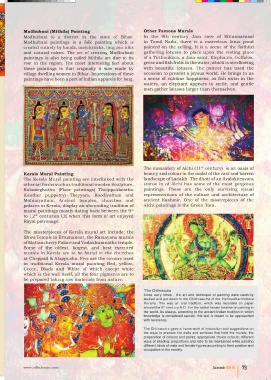
Madhubani (Mithila) Painting                          Other Famous Murals
            Madhubani  is  a  district  in  the  state  of  Bihar.    In the 9th century Jain cave of Sittannavasal
            Madhubani paintings is a folk painting which is       in Tamil  Nadu, there is a marvelous lotus pond
            created entirely by hands, matchsticks, twig pen nibs   painted on the ceiling. It is a scene of the faithful
            and natural colors. The art of creating Madhubani     gathering lotuses to place upon the resting  place
            paintings is also being called Mithila art due to its   of a Tirthankara, a Jain saint. Elephants, buffalos,
            root in the region. The most interesting fact about   geese and fish frolic in the water, which is overflowing
            these paintings is that originally it was made by     with  beautiful  lotuses.  The painter has used the
            village dwelling women in Bihar. Impressions of these   occasion to present a joyous world. He brings to us
            paintings have been a part of Indian apparels for long.  a sense of sublime happiness; as fish swim in the
                                                                  waters,  an elephant appears to  smile,  and gentle
                                                                  men gather lotuses larger than themselves.


                                                                  The monastery of Alchi (11  century)  is an oasis of
                                                                                             th
            Kerala Mural Painting                                 beauty and colour in the midst of the vast and barren
            The Kerala Mural painting are interlinked with the    landscape of Ladakh. The dhoti of an Avalokitesvara
            other art forms such as traditional wooden Sculpture,   statue in of Alchi has some of the most gorgeous
            Kalameghuthu  (Floor paintings) Tholppakkoothu        paintings.  These are  the  only  surviving  visual
            (Leather  puppetry)  Theyyam,  Koodiyattam  and       representations of the culture and architecture of
            Mohiniyattam.  Ancient temples,  churches and         ancient Kashmir. One of the masterpieces of the
            palaces in Kerala, display an abounding tradition of   Alchi paintings is the Green Tara.
            mural paintings mostly dating back between the 9
                                                             th
            to 12  centuries CE when this form of art enjoyed
                 th
            Royal patronage.
            The masterpieces of Kerala mural art include: the
            Shiva Temple in Ettumanoor, the Ramayana murals
            of Mattancherry Palace and Vadakkumnatha temple.
            Some of the oldest,  largest,  and best executed
            murals in Kerala are to be found in the churches
            at Cheppad & Alappuzha. Five are the colours used
            in traditional  Kerala mural painting Red, yellow,
            Green,  Black  and White  of  which except white
            which is the wall itself, all the four pigments are to
            be prepared taking raw materials from nature.

                                                                  *The Chithrasutra
                                                                  Since early times , the art and technique  of painting  were carefully
                                                                  studied and put down in the Chithrasutra of the Vishnudharmottara
                                                                  Purana.  This was an oral  tradition, which  was recorded  on paper
                                                                  around the 5  century A.D. It is the oldest known treatise on paining in
                                                                           th
                                                                  the world. As always, according to the ancient Indian tradition in which
                                                                  knowledge is considered sacred, this text is meant to be approached
                                                                  with reverence.
                                                                  The Chitrasutra gave a frame work of instruction and suggestions on
                                                                  the ways to prepare the walls and surfaces that hold the murals; the
                                                                  preparation of colours and paints; appropriate choice colours; different
                                                                  ways of shading; proportions and ratio to be maintained while painting
                                                                  different kinds of male and female figures according to their position and
                                                                  occupation in the society.


            www.sifbahrain.com                                                                    Scientech 2014-15  79

