


Page 33 - 2022-08-01 Paddling Magazine
P. 33
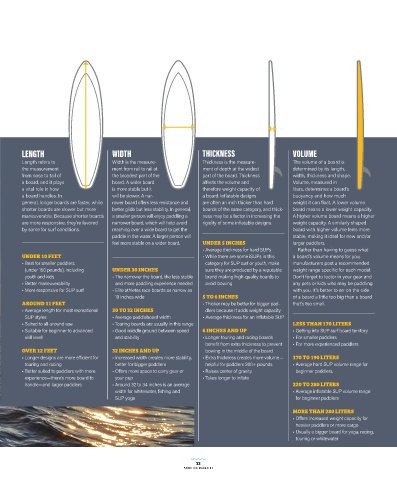
LENGTH                        WIDTH                        THICKNESS                     VOLUME
        Length refers to              Width is the measure-        Thickness is the measure-     The volume of a board is
        the measurement               ment from rail to rail at    ment of depth at the widest   determined by its length,
        from nose to tail of          the broadest part of the     part of the board. Thickness   width, thickness and shape.
        a board, and it plays         board. A wider board         affects the volume and        Volume, measured in
        a vital role in how           is more stable but it        therefore weight capacity of   liters, determines a board’s
        a board handles. In           will be slower. A nar-       a board. Inflatable designs   buoyancy and how much
        general, longer boards are faster, while   rower board offers less resistance and   are often an inch thicker than hard   weight it can float. A lower volume
        shorter boards are slower but more   better glide but less stability. In general,   boards of the same category, and thick-  board means a lower weight capacity.
        maneuverable. Because shorter boards   a smaller person will enjoy paddling a   ness may be a factor in increasing the   A higher volume board means a higher
        are more responsive, they’re favored   narrower board, which will help avoid   rigidity of some inflatable designs.   weight capacity. A similarly shaped
        by some for surf conditions.   reaching over a wide board to get the                     board with higher volume feels more
                                      paddle in the water. A larger person will                  stable, making it ideal for new and/or
                                      feel more stable on a wider board.    UNDER 5 INCHES       larger paddlers.
                                                                   •  Average thickness for hard SUPs  Rather than having to guess what
        UNDER 10 FEET                                              •  While there are some iSUPs in this   a board’s volume means for you,
        •  Best for smaller paddlers                                category for SUP surf or youth, make   manufacturers post a recommended
         (under 150 pounds), including    UNDER 30 INCHES           sure they are produced by a reputable   weight range specific for each model.
         youth and kids               •  The narrower the board, the less stable   brand making high-quality boards to   Don’t forget to factor in your gear and
        •  Better maneuverability      and more paddling experience needed  avoid bowing         any pets or kids who may be paddling
        •  More responsive for SUP surf  •  Elite athletes race boards as narrow as              with you. It’s better to err on the side
                                       19 inches wide              5 TO 6 INCHES                 of a board a little too big than a board
        AROUND 11 FEET                                             •  Thicker may be better for bigger pad-  that’s too small.
        •  Average length for most recreational   30 TO 32 INCHES   dlers because it adds weight capacity
         SUP styles                   •  Average paddleboard width  •  Average thickness for an inflatable SUP
        •  Suited to all-around use   •  Touring boards are usually in this range                LESS THAN 170 LITERS
        •  Suitable for beginner to advanced    •  Good middle ground between speed   6 INCHES AND UP  •  Getting into SUP surf board territory
         skill level                   and stability               •  Longer touring and racing boards   •  For smaller paddlers
                                                                    benefit from extra thickness to prevent   •  For more experienced paddlers
        OVER 12 FEET                  32 INCHES AND UP              bowing in the middle of the board
        •  Longer designs are more efficient for   •  Increased width creates more stability,   •  Extra thickness creates more volume—  170 TO 190 LITERS
         touring and racing            better for bigger paddlers   helpful for paddlers 200+ pounds  •  Average hard SUP volume range for
        •  Better suited to paddlers with more   •  Offers more space to carry gear or   •  Raises center of gravity  beginner paddlers.
         experience—there’s more board to   your pup               •  Takes longer to inflate
         handle—and larger paddlers   •  Around 32 to 34 inches is an average                    220 TO 280 LITERS
                                       width for whitewater, fishing and                         •  Average inflatable SUP volume range
                                       SUP yoga                                                   for beginner paddlers

                                                                                                 MORE THAN 280 LITERS
                                                                                                 •  Offers increased weight capacity for
                                                                                                  heavier paddlers or more cargo
                                                                                                 •  Usually a bigger board for yoga, racing,
                                                                                                  touring or whitewater


                                                                 33
                                                             P A D D L IN G  M A G A Z IN E

