


Page 50 - 2022-08-01 Paddling Magazine
P. 50
KAYAK ANGLER


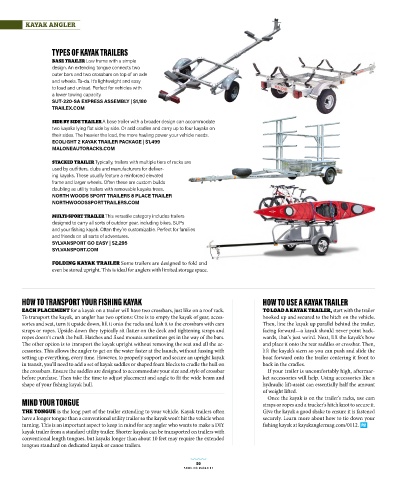
                  TYPES OF KAYAK TRAILERS
                  BASE TRAILER Low frame with a simple
                  design. An extending tongue connects two
                  outer bars and two crossbars on top of an axle
                  and wheels. Ta-da. It’s lightweight and easy
                  to load and unload. Perfect for vehicles with
                  a lower towing capacity.
                  SUT-220-SA EXPRESS ASSEMBLY | $1,180
                  TRAILEX.COM

                  SIDE BY SIDE TRAILER A base trailer with a broader design can accommodate
                  two kayaks lying flat side by side. Or add cradles and carry up to four kayaks on
                  their sides. The heavier the load, the more hauling power your vehicle needs.
                  ECOLIGHT 2 KAYAK TRAILER PACKAGE | $1,499
                  MALONEAUTORACKS.COM
                  STACKED TRAILER Typically, trailers with multiple tiers of racks are
                  used by outfitters, clubs and manufacturers for deliver-
                  ing kayaks. These usually feature a reinforced elevated
                  frame and larger wheels. Often these are custom builds
                  doubling as utility trailers with removable kayaks trees.
                  NORTH WOODS SPORT TRAILERS 8 PLACE TRAILER
                  NORTHWOODSSPORTTRAILERS.COM
                  MULTI-SPORT TRAILER This versatile category includes trailers
                  designed to carry all sorts of outdoor gear, including bikes, SUPs
                  and your fishing kayak. Often they’re customizable. Perfect for families
                  and friends on all sorts of adventures.
                  SYLVANSPORT GO EASY | $2,295
                  SYLVANSPORT.COM

                  FOLDING KAYAK TRAILER Some trailers are designed to fold and
                  even be stored upright. This is ideal for anglers with limited storage space.


        HOW TO TRANSPORT YOUR FISHING KAYAK                                            HOW TO USE A KAYAK TRAILER
        EACH PLACEMENT for a kayak on a trailer will have two crossbars, just like on a roof rack.   TO LOAD A KAYAK TRAILER, start with the trailer
        To transport the kayak, an angler has two options: One is to empty the kayak of gear, acces-  hooked up and secured to the hitch on the vehicle.
        sories and seat, turn it upside down, lift it onto the racks and lash it to the crossbars with cam   Then, line the kayak up parallel behind the trailer,
        straps or ropes. Upside-down they typically sit flatter on the deck and tightening straps and   facing forward—a kayak should never point back-
        ropes doesn't crush the hull. Hatches and fixed mounts sometimes get in the way of the bars.   wards, that's just weird. Next, lift the kayak’s bow
        The other option is to transport the kayak upright without removing the seat and all the ac-  and place it onto the rear saddles or crossbar. Then,
        cessories. This allows the angler to get on the water faster at the launch, without fussing with   lift the kayak’s stern so you can push and slide the
        setting up everything, every time. However, to properly support and secure an upright kayak   boat forward onto the trailer centering it front to
        in transit, you’ll need to add a set of kayak saddles or shaped foam blocks to cradle the hull on   back in the cradles.
        the crossbars. Ensure the saddles are designed to accommodate your size and style of crossbar   If your trailer is uncomfortably high, aftermar-
        before purchase. Then take the time to adjust placement and angle to fit the wide beam and   ket accessories will help. Using accessories like a
        shape of your fishing kayak hull.                                              hydraulic lift-assist can essentially half the amount
                                                                                       of weight lifted.
                                                                                        Once the kayak is on the trailer’s racks, use cam
        MIND YOUR TONGUE                                                               straps or ropes and a trucker's hitch knot to secure it.
        THE TONGUE is the long part of the trailer extending to your vehicle. Kayak trailers often   Give the kayak a good shake to ensure it is fastened
        have a longer tongue than a conventional utility trailer so the kayak won’t hit the vehicle when   securely. Learn more about how to tie down your
        turning. This is an important aspect to keep in mind for any angler who wants to make a DIY   fishing kayak at kayakanglermag.com/0112.  PM
        kayak trailer from a standard utility trailer. Shorter kayaks can be transported on trailers with
        conventional length tongues, but kayaks longer than about 10 feet may require the extended
        tongues standard on dedicated kayak or canoe trailers.


                                                                 50
                                                             P A D D L IN G  M A G A Z IN E

