


Page 74 - 2022-08-01 Paddling Magazine
P. 74
CANOEING


       ILLUSTRATION: AMY MAY


                  CANOES
                  Help From Above


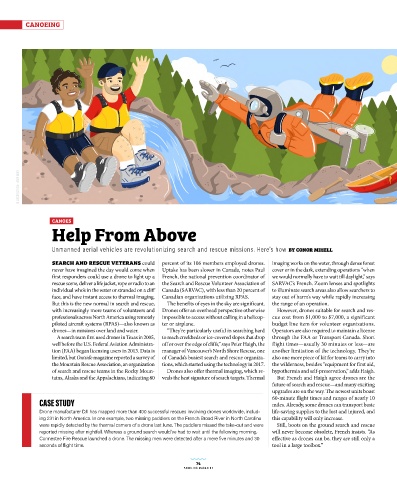
                  Unmanned aerial vehicles are revolutionizing search and rescue missions. Here’s how by conor mihell

                  SEARCH AND RESCUE VETERANS could    percent of its 106 members employed drones.   imaging works on the water, through dense forest
                  never have imagined the day would come when   Uptake has been slower in Canada, notes Paul   cover or in the dark, extending operations “when
                  first responders could use a drone to light up a   French, the national prevention coordinator of   we would normally have to wait till daylight,” says
                  rescue scene, deliver a life jacket, rope or radio to an   the Search and Rescue Volunteer Association of   SARVAC’s French. Zoom lenses and spotlights
                  individual who’s in the water or stranded on a cliff   Canada (SARVAC), with less than 20 percent of   to illuminate search areas also allow searchers to
                  face, and have instant access to thermal imaging.   Canadian organizations utilizing RPAS.   stay out of harm’s way while rapidly increasing
                  But this is the new normal in search and rescue,   The benefits of eyes in the sky are significant.   the range of an operation.
                  with increasingly more teams of volunteers and   Drones offer an overhead perspective otherwise   However, drones suitable for search and res-
                  professionals across North America using remotely   impossible to access without calling in a helicop-  cue cost from $1,000 to $7,000, a significant
                  piloted aircraft systems (RPAS)—also known as   ter or airplane.        budget line item for volunteer organizations.
                  drones—in missions over land and water.   “They’re particularly useful in searching hard   Operators are also required to maintain a license
                    A search team first used drones in Texas in 2005,   to reach creekbeds or ice-covered slopes that drop   through the FAA or Transport Canada. Short
                  well before the U.S. Federal Aviation Administra-  off or over the edge of cliffs,” says Peter Haigh, the   flight times—usually 30 minutes or less—are
                  tion (FAA) began licensing users in 2013. Data is   manager of Vancouver’s North Shore Rescue, one   another limitation of the technology. They’re
                  limited, but Outside magazine reported a survey of   of Canada’s busiest search and rescue organiza-  also one more piece of kit for teams to carry into
                  the Mountain Rescue Association, an organization   tions, which started using the technology in 2017.  the wilderness, besides “equipment for first aid,
                  of search and rescue teams in the Rocky Moun-  Drones also offer thermal imaging, which re-  hypothermia and self-preservation,” adds Haigh.
                  tains, Alaska and the Appalachians, indicating 80   veals the heat signature of search targets. Thermal   But French and Haigh agree drones are the
                                                                                          future of search and rescue—and many exciting
                                                                                          upgrades are on the way. The newest units boast
              CASE STUDY                                                                  60-minute flight times and ranges of nearly 10
                                                                                          miles. Already, some drones can transport basic
              Drone manufacturer DJI has mapped more than 400 successful rescues involving drones worldwide, includ-  life-saving supplies to the lost and injured, and
              ing 231 in North America. In one example, two missing paddlers on the French Broad River in North Carolina   this capability will only increase.
              were rapidly detected by the thermal camera of a drone last June. The paddlers missed the take-out and were   Still, boots on the ground search and rescue
              reported missing after nightfall. Whereas a ground search would’ve had to wait until the following morning,   will never become obsolete, French insists. “As
              Connestee Fire Rescue launched a drone. The missing men were detected after a mere five minutes and 30   effective as drones can be, they are still only a
              seconds of flight time.                                                     tool in a large toolbox.”


                                                                 74
                                                             P A D D L IN G  M A G A Z IN E

