


Page 43 - FDI Alliance International Magazine. Spring 2021 Digital Interactive Issue
P. 43
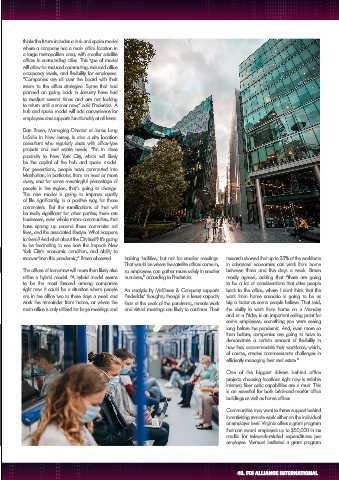
thinks the future includes a hub and spoke model
         where a company has a main office location in
         a large metropolitan area, with smaller satellite
         offices in surrounding cities. This type of model
         will allow for reduced commuting, reduced office
         occupancy levels, and flexibility for employees.
         “Companies are all over the board with their
         return to the office strategies. Some that had
         planned on going back in January have had
         to readjust several times and are not looking
         to return until summer now,” said Fredericks. A
         hub and spoke model will add convenience for
         employees and supports functionality at all levels.

         Dan Breen, Managing Director at Jones Lang
         LaSalle in New Jersey, is also a site location
         consultant who regularly deals with office-type
         projects and real estate needs. “I'm in close
         proximity to New York City, which will likely
         be the capital of the hub and spoke model.
         For generations, people have commuted into
         Manhattan, in particular, from an hour or more
         away, and for some meaningful percentage of
         people in the region, that’s going to change.
         The new model is going to improve quality
         of life significantly, in a positive way, for those
         commuters. But the  ramifications of  that will
         be really significant for other parties; there are
         businesses, even whole micro-communities, that
         have sprung up around these commuter rail
         lines, and the associated lifestyle. What happens
         to them? And what about the City itself? It’s going
 THE FUTURE OF THE OFFICE  York City’s economic condition, and ability to   training facilities, but not for smaller meetings.  research showed that up to 25% of the workforce
         to be fascinating to see how this impacts New
         recover from this pandemic,” Breen observed.
                                                                                in advanced economies can work from home
                                            That would be where the satellite offices come in,
         The offices of tomorrow will more than likely also
         utilize a hybrid model. “A hybrid model seems   so employees can gather more safely in smaller   between three and five days a week. Breen
                                                                                mostly agreed, adding that “there are going
                                            numbers,” according to Fredericks.
         to be the most favored among companies                                 to be a lot of considerations that drive people
         right now. It could be a situation where people   An analysis by McKinsey & Company supports   back to the office, where I don't think that the
         are in the office two to three days a week and   Fredericks’ thoughts; though in a lesser capacity   work from home scenario is going to be as
         work the remainder from home, or where the   than at the peak of the pandemic, remote work   big a factor as some people believe. That said,
         main office is only utilized for large meetings and   and virtual meetings are likely to continue. Their   the ability to work from home on a Monday
                                                                                and or a Friday is an important selling point for
                                                                                some employees, something you were seeing
 In a span of a few days, the world went from  planning to bring back their workforce by the  people expect more flexible work arrangements   long before the pandemic. And, even more so
 bustling business-as-usual to deserted urban   end of March, according to a report from The   from here on out: 54% of respondents expect to   than before, companies are going to have to
 cores, not unlike those described in popular   Conference Board.   work from home at least one day a week. Add to   demonstrate a certain amount of flexibility in
 dystopian fiction books. Vast amounts of office   it, a new Korn Ferry survey found that nearly two-  how they accommodate their workforce, which,
 spaces sat completely empty for months and   Corporate giants like Dropbox have made their   thirds (64%) of respondents are more productive   of course, creates commensurate challenges in
 months, and with each passing day speculations   entire workforce permanently remote. Facebook   at home.   efficiently managing their real estate.”
 grew about what would happen with the excess   will allow up to half its employees to work remote
 spaces.   permanently. American Express and Capital One   On the flipside, the Steelcase survey found that the   One of the biggest drivers behind office
 are planning to keep their respective staffs remote   top two reasons folks want to return to the office   projects choosing locations right now is reliable
 Now, an entire year later, the world is still battling   until at least Labor Day 2021. All this in stark   are to connect with colleagues and reconnect to   internet; fiber optic capabilities are a must. This
 a pandemic, major metropolitan business   contrast to the finding that 60% of employees   the organization and shared purpose.   is an essential for both brick-and-mortar office
 centers are still largely working from home, and   expected to be back in the office by the end   buildings as well as home offices.
 corporate executives are continuing to strategize   of Q1 2021, according to  data gathered  by   So, that begs the question, what is the future of
 where to go from here.   CREtech.  the office?                                 Communities may want to throw support behind
                                                                                incentivizing remote work either on the individual
 It is unlikely that offices will return to pre-COVID   When thinking from the individual perspective,   Sara Fredericks, Director at Newmark in Dallas,   or employer level. Virginia offers a grant program
 levels of occupancy any time soon. Vaccinations   the needs of office workers have changed. Office  Texas, is a site location consultant who works   that can award employers up to $50,000 in tax
 are rolling out and consumer confidence is   furniture manufacturer Steelcase surveyed 32,000   regularly with locating corporate office projects.   credits for telework-related expenditures per
 rising, though only about 40% of employers were   people in 10 different countries. They found that   Based on her experiences over the past year, she   employee. Vermont instituted a grant program


                                                                                    43. FDI ALLIANCE INTERNATIONAL

