


Page 16 - FDI Alliance International Magazine.
Winter 2020 Digital Interactive Issue.
P. 16
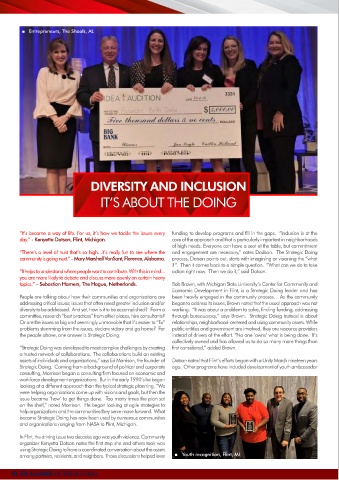
■   Entrepreneurs, The Shoals, AL


                                 DIVERSITY AND INCLUSION

                                    IT’S ABOUT THE DOING


        “It’s become a way of life. For us, it’s how we tackle the issues every  funding to develop programs and fill in the gaps.  “Inclusion is at the
        day.” - Kenyetta Dotson, Flint, Michigan.            core of the approach and that is particularly important in neighborhoods
                                                             of high needs. Everyone can have a seat at the table, but commitment
        “There’s a level of trust that’s so high...it’s really fun to see where the  and engagement are necessary,” notes Dodson.  The Strategic Doing
        community is going next.” – Mary Marshall VanSant, Florence, Alabama.  process, Dotson points out, starts with imagining or visioning the “what
                                                             if”.  Then it comes back to a simple question.  “What can we do to take
        “It helps to understand where people want to contribute. With this in mind...  action right now.  Then we do it,” said Dotson.
        you are more likely to debate and discuss more openly on certain heavy
        topics.” – Sebastian Hamers, The Hague, Netherlands.  Bob Brown, with Michigan State University’s Center for Community and
                                                             Economic Development in Flint, is a Strategic Doing leader and has
        People are talking about how their communities and organizations are  been heavily engaged in the community process.   As the community
        addressing critical issues; issues that often need greater inclusion and/or   began to address its issues, Brown noted that the usual approach was not
        diversity to be addressed.  And yet, how is it to be accomplished?   Form a   working.  “It was about a problem to solve, finding funding, addressing
        committee, research “best practices” from other places, hire consultants?  through bureaucracy,” says Brown.  Strategic Doing instead is about

        Or are the issues so big and seemingly unmovable that it’s easier to “fix”  relationships, neighborhood-centered and using community assets. While
        problems stemming from the issues, declare victory and go home?  For  public entities and government are involved, they are resource providers
        the people above, one answer is Strategic Doing.     instead of drivers of the effort. “No one ‘owns’ what is being done.  It’s
                                                             collectively owned and has allowed us to do so many more things than
        “Strategic Doing was developed to meet complex challenges by creating  first considered,” added Brown.
        a trusted network of collaborations.  The collaborations build on existing
        assets of individuals and organizations,” says Ed Morrison, the founder of   Dotson noted that Flint’s efforts began with a Unity March nineteen years
        Strategic Doing.  Coming from a background of political and corporate  ago.  Other programs have included development of youth ambassador
        consulting, Morrison began a consulting firm focused on economic and
        workforce development organizations.  But in the early 1990’s he began
        looking at a different approach than the typical strategic planning. “We
        were helping organizations come up with visions and goals, but then the
        issue became ‘how’ to get things done.  Too many times the plan sat
        on the shelf,” noted Morrison.  He began looking at agile strategies to
        help organizations and the communities they serve move forward.  What
        became Strategic Doing has now been used by numerous communities
        and organizations ranging from NASA to Flint, Michigan.

        In Flint, the driving issue two decades ago was youth violence. Community
        organizer Kenyetta Dotson notes the first step she and others took was
        using Strategic Doing to have a coordinated conversation about the assets
        among partners, residents, and neighbors. Those discussions helped lever   ■   Youth recognition, Flint, MI


     16. FDI ALLIANCE INTERNATIONAL

