


Page 199 - English Class 9
P. 199
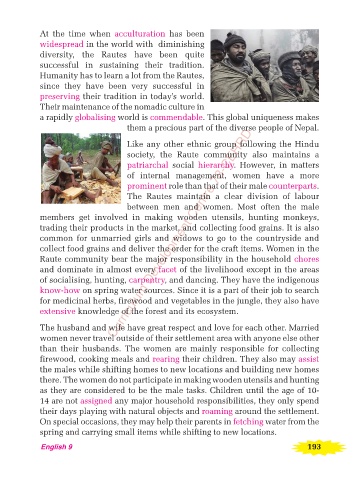
At the time when  acculturation has been
            widespread in the world with  diminishing
            diversity, the Rautes have been quite
            successful in sustaining their tradition.
            Humanity has to learn a lot from the Rautes,
            since they have been very successful in
            preserving their tradition in today's world.
            Their maintenance of the nomadic culture in
            a rapidly globalising world is commendable. This global uniqueness makes
                                     them a precious part of the diverse people of Nepal.
                                 Curriculum Development Centre 78-CEHRD
 Curriculum Development Centre 78-CEHRD
                                     Like any other ethnic group following the Hindu
                                     society, the Raute community also maintains a
                                     patriarchal  social  hierarchy.  However,  in  matters
                                     of internal management, women have a more
                                     prominent role than that of their male counterparts.
                                     The Rautes  maintain a clear  division of labour
                                     between  men and women. Most often  the male
            members  get  involved in making wooden utensils, hunting monkeys,
            trading their products in the market, and collecting food grains. It is also
            common for unmarried girls and widows to go to the countryside and
            collect food grains and deliver the order for the craft items. Women in the
            Raute community bear the major responsibility in the household chores
            and dominate in almost every facet of the livelihood except in the areas
            of socialising, hunting, carpentry, and dancing. They have the indigenous
            know-how on spring water sources. Since it is a part of their job to search
            for medicinal herbs, firewood and vegetables in the jungle, they also have
            extensive knowledge of the forest and its ecosystem.

            The husband and wife have great respect and love for each other. Married
            women never travel outside of their settlement area with anyone else other
            than their  husbands. The  women are  mainly responsible  for  collecting
            firewood, cooking meals and rearing their children. They also may assist
            the males while shifting homes to new locations and building new homes
            there. The women do not participate in making wooden utensils and hunting
            as they are considered to be the male tasks. Children until the age of 10-
            14 are not assigned any major household responsibilities, they only spend
            their days playing with natural objects and roaming around the settlement.
            On special occasions, they may help their parents in fetching water from the
            spring and carrying small items while shifting to new locations.
             English 9                                                                  193

