


Page 73 - English Class 9
P. 73
body when I was 12 and it had a profound effect on me.

            Before we knew it, the bag was taken off and the corpse was revealed. It
            looked like a middle-aged woman.

            The  Rogyapa, body breaker,  stormed up the side of mountain. He was
            dressed in  a  thick,  dark  scarlet  coloured coat with  a  black  hood.  With
            a butcher knife in hand, he wasted no time in carving up the body. My
            stomach sunk. It was gruesome, and I just stopped myself from throwing
            up. My kids though seemed to take it in their stride.

            The vultures were growing impatient and started to jump at site of the
            flesh. The body breaker gave the signal and the Tibetans holding the birds
            back let them through.

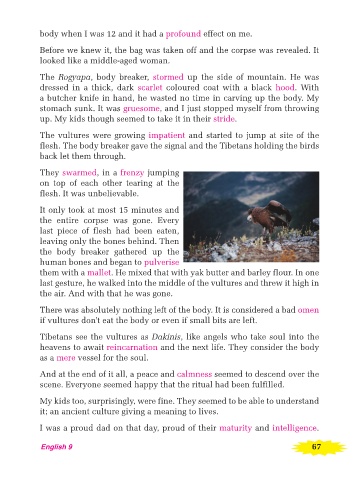
            They swarmed, in a frenzy jumping
            on top of each other tearing at the
            flesh. It was unbelievable.

            It only took at most 15 minutes and
            the entire corpse was gone. Every
            last piece of flesh had been eaten,
            leaving only the bones behind. Then
            the body breaker gathered  up the
            human bones and began to pulverise
            them with a mallet. He mixed that with yak butter and barley flour. In one
            last gesture, he walked into the middle of the vultures and threw it high in
            the air. And with that he was gone.

            There was absolutely nothing left of the body. It is considered a bad omen
            if vultures don't eat the body or even if small bits are left.

            Tibetans see the vultures as Dakinis, like angels who take soul into the
            heavens to await reincarnation and the next life. They consider the body
            as a mere vessel for the soul.

            And at the end of it all, a peace and calmness seemed to descend over the
            scene. Everyone seemed happy that the ritual had been fulfilled.

            My kids too, surprisingly, were fine. They seemed to be able to understand
            it; an ancient culture giving a meaning to lives.

            I was a proud dad on that day, proud of their maturity and intelligence.

             English 9                                                                    67

