


Page 79 - English Class 9
P. 79
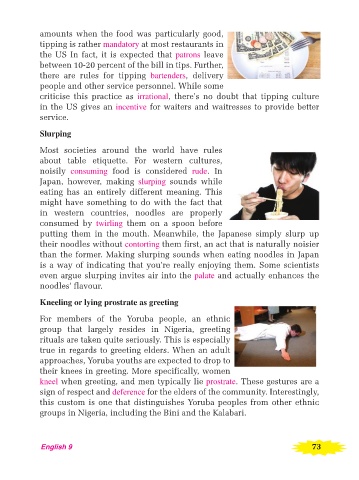
amounts when the food was particularly good,
            tipping is rather mandatory at most restaurants in
            the US In fact, it is expected that patrons leave
            between 10-20 percent of the bill in tips. Further,
            there  are  rules for tipping  bartenders, delivery
            people and other service personnel. While some
            criticise this practice  as  irrational, there’s  no doubt that tipping culture
            in the US gives an incentive for waiters and waitresses to provide better
            service.

            Slurping

            Most societies around the world have rules
            about  table etiquette.  For  western  cultures,
            noisily  consuming food is considered  rude. In
            Japan,  however,  making  slurping  sounds  while
            eating has an entirely  different  meaning. This
            might have something to do with the fact that
            in western  countries,  noodles are  properly
            consumed by  twirling them on a spoon before
            putting them in the mouth. Meanwhile, the Japanese simply  slurp up
            their noodles without contorting them first, an act that is naturally noisier
            than the former. Making slurping sounds when eating noodles in Japan
            is a way of indicating that you’re really enjoying them. Some scientists
            even argue slurping invites air into the palate and actually enhances the
            noodles’ flavour.
            Kneeling or lying prostrate as greeting


            For  members of the Yoruba  people, an ethnic
            group that largely resides in Nigeria,  greeting
            rituals are taken quite seriously. This is especially
            true in regards to greeting elders. When an adult
            approaches, Yoruba youths are expected to drop to
            their knees in greeting. More specifically, women
            kneel when greeting, and men typically lie prostrate. These gestures are a
            sign of respect and deference for the elders of the community. Interestingly,
            this custom is one that distinguishes Yoruba peoples from other ethnic
            groups in Nigeria, including the Bini and the Kalabari.


             English 9                                                                    73

