


Page 86 - English Class 9
P. 86
A

            Animals do many different, amazing things
            to get  through the winter. Some of them
            migrate. This means they travel to other
            places where the weather is warmer or they
            can find  food.  Many  birds  migrate in  the
            autumn. Because the trip can be dangerous,
            some travel in large  flocks. For example,
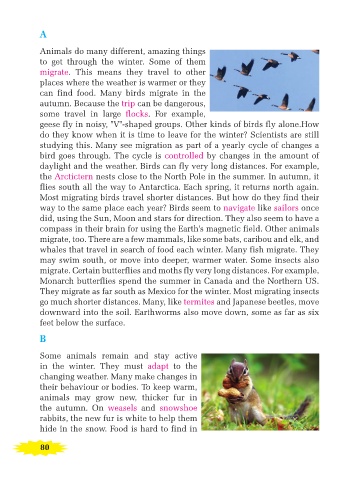
            geese fly in noisy, "V"-shaped groups. Other kinds of birds fly alone.How
            do they know when it is time to leave for the winter? Scientists are still
            studying this. Many see migration as part of a yearly cycle of changes a
            bird goes through. The cycle is controlled by changes in the amount of
            daylight and the weather. Birds can fly very long distances. For example,
            the Arctictern nests close to the North Pole in the summer. In autumn, it
            flies south all the way to Antarctica. Each spring, it returns north again.
            Most migrating birds travel shorter distances. But how do they find their
            way to the same place each year? Birds seem to navigate like sailors once
            did, using the Sun, Moon and stars for direction. They also seem to have a
            compass in their brain for using the Earth's magnetic field. Other animals
            migrate, too. There are a few mammals, like some bats, caribou and elk, and
            whales that travel in search of food each winter. Many fish migrate. They
            may swim south, or move into deeper, warmer water. Some insects also
            migrate. Certain butterflies and moths fly very long distances. For example,
            Monarch butterflies spend the summer in Canada and the Northern US.
            They migrate as far south as Mexico for the winter. Most migrating insects
            go much shorter distances. Many, like termites and Japanese beetles, move
            downward into the soil. Earthworms also move down, some as far as six
            feet below the surface.

            B

            Some animals remain and stay active
            in the  winter. They  must  adapt  to the
            changing weather. Many make changes in
            their behaviour or bodies. To keep warm,
            animals  may grow new, thicker fur in
            the autumn.  On  weasels  and  snowshoe
            rabbits, the new fur is white to help them
            hide in the snow. Food is hard to find in

            80                                                                       English 9

