


Page 142 - A Mind For Numbers: How to Excel at Math and Science
P. 142
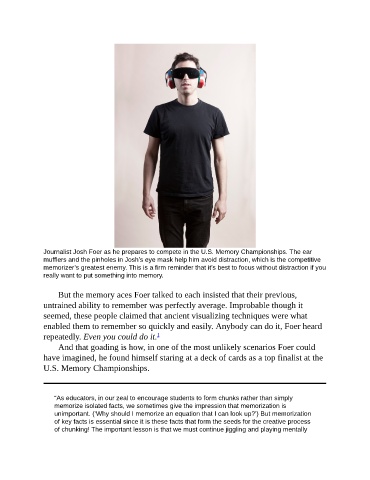
Journalist Josh Foer as he prepares to compete in the U.S. Memory Championships. The ear
               mufflers and the pinholes in Josh’s eye mask help him avoid distraction, which is the competitive
               memorizer’s greatest enemy. This is a firm reminder that it’s best to focus without distraction if you
               really want to put something into memory.


                    But the memory aces Foer talked to each insisted that their previous,
               untrained ability to remember was perfectly average. Improbable though it
               seemed, these people claimed that ancient visualizing techniques were what

               enabled them to remember so quickly and easily. Anybody can do it, Foer heard
               repeatedly. Even you could do it.     1
                    And that goading is how, in one of the most unlikely scenarios Foer could
               have imagined, he found himself staring at a deck of cards as a top finalist at the
               U.S. Memory Championships.


                   “As educators, in our zeal to encourage students to form chunks rather than simply
                   memorize isolated facts, we sometimes give the impression that memorization is
                   unimportant. (‘Why should I memorize an equation that I can look up?’) But memorization
                   of key facts is essential since it is these facts that form the seeds for the creative process
                   of chunking! The important lesson is that we must continue jiggling and playing mentally

