


Page 183 - A Mind For Numbers: How to Excel at Math and Science
P. 183
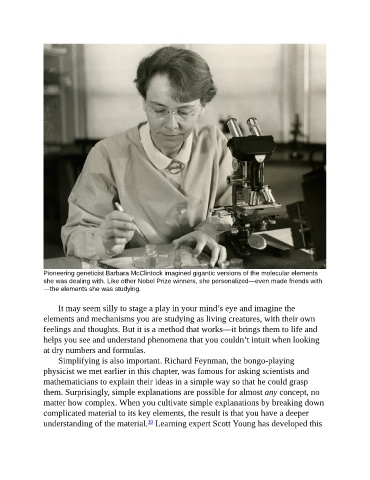
Pioneering geneticist Barbara McClintock imagined gigantic versions of the molecular elements
               she was dealing with. Like other Nobel Prize winners, she personalized—even made friends with
               —the elements she was studying.


                    It may seem silly to stage a play in your mind’s eye and imagine the
               elements and mechanisms you are studying as living creatures, with their own
               feelings and thoughts. But it is a method that works—it brings them to life and
               helps you see and understand phenomena that you couldn’t intuit when looking

               at dry numbers and formulas.
                    Simplifying is also important. Richard Feynman, the bongo-playing
               physicist we met earlier in this chapter, was famous for asking scientists and
               mathematicians to explain their ideas in a simple way so that he could grasp
               them. Surprisingly, simple explanations are possible for almost any concept, no
               matter how complex. When you cultivate simple explanations by breaking down
               complicated material to its key elements, the result is that you have a deeper
                                                  10
               understanding of the material.  Learning expert Scott Young has developed this

