


Page 199 - A Mind For Numbers: How to Excel at Math and Science
P. 199
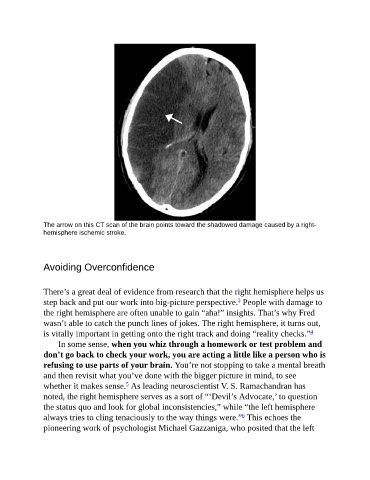
The arrow on this CT scan of the brain points toward the shadowed damage caused by a right-
               hemisphere ischemic stroke.


               Avoiding Overconfidence


               There’s a great deal of evidence from research that the right hemisphere helps us
                                                                                3
               step back and put our work into big-picture perspective.  People with damage to
               the right hemisphere are often unable to gain “aha!” insights. That’s why Fred
               wasn’t able to catch the punch lines of jokes. The right hemisphere, it turns out,
               is vitally important in getting onto the right track and doing “reality checks.”         4
                    In some sense, when you whiz through a homework or test problem and
               don’t go back to check your work, you are acting a little like a person who is

               refusing to use parts of your brain. You’re not stopping to take a mental breath
               and then revisit what you’ve done with the bigger picture in mind, to see
                                           5
               whether it makes sense.  As leading neuroscientist V. S. Ramachandran has
               noted, the right hemisphere serves as a sort of “‘Devil’s Advocate,’ to question
               the status quo and look for global inconsistencies,” while “the left hemisphere
                                                                                 6
               always tries to cling tenaciously to the way things were.”  This echoes the
               pioneering work of psychologist Michael Gazzaniga, who posited that the left

