


Page 206 - A Mind For Numbers: How to Excel at Math and Science
P. 206
INSIGHTS ON LEARNING FROM PHYSICS PROFESSOR BRAD ROTH, A FELLOW
                      OF THE AMERICAN PHYSICAL SOCIETY AND CO-AUTHOR OF INTERMEDIATE
                                         PHYSICS FOR MEDICINE AND BIOLOGY


                                            “One thing I stress in my classes is to think before you calculate. I
                                            really hate the ‘plug and chug’ approach that many students use.
                                            Also, I find myself constantly reminding students that equations are
                                            NOT merely expressions you plug numbers into to get other
                                            numbers. Equations tell a story about how the physical world
                                            works. For me, the key to understanding an equation in physics is
                                            to see the underlying story. A qualitative understanding of an
                                            equation is more important than getting quantitatively correct
                                            numbers out of it.
                                               “Here are a few more tips:
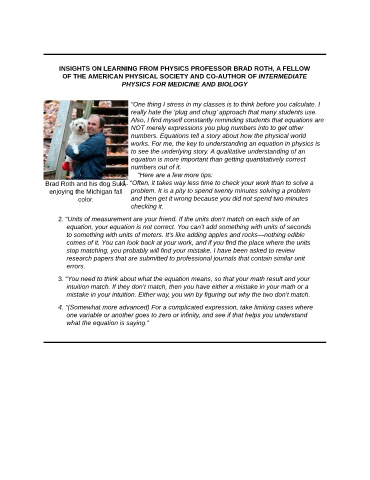
                Brad Roth and his dog Suki, 1. “Often, it takes way less time to check your work than to solve a
                 enjoying the Michigan fall  problem. It is a pity to spend twenty minutes solving a problem
                           color.           and then get it wrong because you did not spend two minutes
                                            checking it.

                    2. “Units of measurement are your friend. If the units don’t match on each side of an
                       equation, your equation is not correct. You can’t add something with units of seconds
                       to something with units of meters. It’s like adding apples and rocks—nothing edible
                       comes of it. You can look back at your work, and if you find the place where the units
                       stop matching, you probably will find your mistake. I have been asked to review
                       research papers that are submitted to professional journals that contain similar unit
                       errors.

                    3. “You need to think about what the equation means, so that your math result and your
                       intuition match. If they don’t match, then you have either a mistake in your math or a
                       mistake in your intuition. Either way, you win by figuring out why the two don’t match.

                    4. “(Somewhat more advanced) For a complicated expression, take limiting cases where
                       one variable or another goes to zero or infinity, and see if that helps you understand
                       what the equation is saying.”

